







Article
How to Create a Realistic Budget For Your Restaurant
"If you don't know where you are going, any road will get you there." For restaurant owners there are three "financial" roads, each leading to a different destination. The most preferred route is to take the road to profitability and success. Another, less desirable road is that which leads to break-even, or merely hanging on. But the most treacherous road leads to failure, and in some cases, financial ruin.
Unfortunately, more than 60 percent of all restaurants end up on the most hazardous of these routes by their third year of existence. The vast majority of restaurant failures can be attributed, at least in part, to the absence of a plan or practical budget upon which decisions, accountability and actions are based.
An Organization Plan Expressed In Money
A budget is a fundamental tool by which business owners and managers can predict, with reasonable accuracy, whether their restaurant will profit, break even or lose money. A budget is an organizational plan expressed in monetary terms. It forces management to consider changing conditions and adapt their operations to maintain profitability and consistency of product and service.
The budget is your hypothetical profit-and-loss statement (P&L); therefore, it should be formatted the same as a monthly P&L. (We strongly suggest you adopt the restaurant industry P&L format as recommended by RestaurantOwner.com and the National Restaurant Association.)
Additional Resources: The Best Way to Format Your Restaurant's P&L
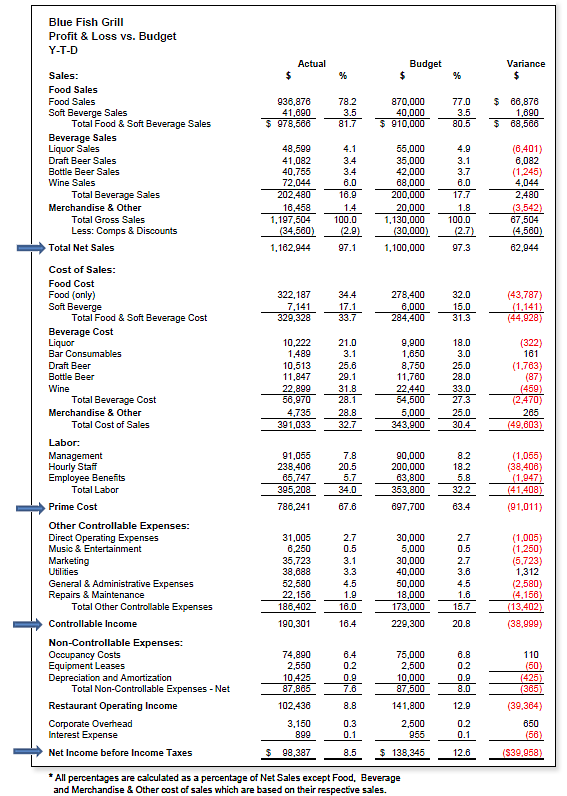
The restaurant P&L and budget formats differ from that of other businesses in that they make it easier to identify the four major checkpoints restaurants need to monitor -- sales, prime cost, controllable profit and net income.
Too few restaurants employ effective budgeting, which is a critical path to effective management and profitability. Integrate the steps described in this article to help turn around inconsistent or lackluster financial performance.
Sales. While this is pretty obvious, the top line is the single biggest profit-determining factor on the P&L. Strong sales volume can make up for quite a few management mistakes and cost control glitches -- at least for a while anyway. It's good to compare current sales with the same period of the prior year and to a budget or forecast. It's also helpful to look at check average and customer counts when comparing sales from one period with another.
Prime cost. Prime cost is the total cost of sales plus all payroll-related costs, including wages, benefits, payroll taxes, workers' compensation and other similar expenses. Keeping close tabs on your prime cost is critical for a number of reasons; it represents your two biggest and most volatile cost areas, and is really one of the few costs over which you have control.
In table-service restaurants, the generally accepted rule says that prime cost should run no more than 65 percent of total sales. Many of the larger, casual-theme chain operators can keep their prime cost 60 percent or less but for most table-service independents achieving a prime cost of 60 percent to 65 percent of sales still provides the opportunity to achieve a healthy net income provided a restaurant has a fairly normal cost-and-expense structure in the other areas of their P&L.
Additional Resources: Why Prime Cost Is the Most Important Number (That Should Be) On Your P&L
Controllable Income. Sometimes referred to as "operating income," controllable income reflects only those expenses over which the operations personnel have any real control or influence. This makes it a good benchmark for evaluating management's overall effectiveness at "running the restaurant."
Net income. Finally, what's left after all the expenses are paid, and hopefully with no brackets around it that indicate a loss. The importance of this number is quite apparent; however, it may be helpful to compare "Net Income" with one or more prior periods to see if you're gaining or losing ground. Another important measure of profitability is to compare annual Net Income with the total investment you have in the restaurant. This is your ROI or "return on investment."
In the "Blue Fish Grill Profit & Loss vs. Budget" example shown below, it's easy to see how each of these four areas is reflected on the financial statement. This particular format includes key ratios and allows the owner to see how to compare results with the annual budget in both dollars and percentages; the importance of percentages is addressed later. In other words, it shows how successful or unsuccessful management was in executing the budget. It provides a definitive measure of what's working and what's not.
Annual Budget vs. Weekly Operating Budget
Typically, an annual budget is created for the following year just before the end of the current year, often sometime during October to December. Extenuating circumstances aside, it does not typically change once established. The purpose of the annual budget is more strategic as opposed to tactical. In other words, the annual budget, while based upon reasonable expectations for sales, cost and expenses, is a goal-oriented objective based upon history and anticipated changes in the upcoming year.
To Continue Learning