







Article
Spot Food Cost Problems by Knowing Your Ideal Food Cost
Raise your hand if you know what your target food cost should be, you are pleased with that target, and you are consistently hitting that target. If you raised your hand, then you don't need to read on; you're probably doing all the things that we'll be discussing.
However, if you're not satisfied with your current food cost, then take this opportunity to learn a proven strategy for controlling one of the biggest cost areas for your restaurant: food cost.
If you're like most operators, you may feel like you've already cut costs to the bone. You've shopped for the best deals, raised your menu prices and cut your portions; still, you're left scratching your head as to why your food cost is still high.
In this article we'll show you how to establish your target food cost, explain the reasons many operators can't hit their target and present some basic tactics for controlling food cost.
Key Point 1: Know Your Food Cost Target
The prerequisite for controlling food cost is to know what your food cost should be -- your food cost target. There are three basic steps for establishing your food cost target. First, you must go through the exercise of costing out your entire menu; second, calculate the ideal cost (sometimes referred to as theoretical cost) based on actual menu sales mix; and third, compare your ideal food cost with that of actual food cost expenditures.
Step 1: Cost Out Your Menu
Costing out your menu is an arduous task, but you must know your menu cost before you can make intelligent decisions on cost-cutting. The first step in calculating your ideal food cost is to cost out your entire food menu, including all recipes and prep items. To accomplish this, you'll need a listing of every ingredient that you use as well as the current cost. Hopefully, you already have an inventory listing and are using it to take weekly or monthly inventories so that you can accurately track your food cost from one week or period to the next.
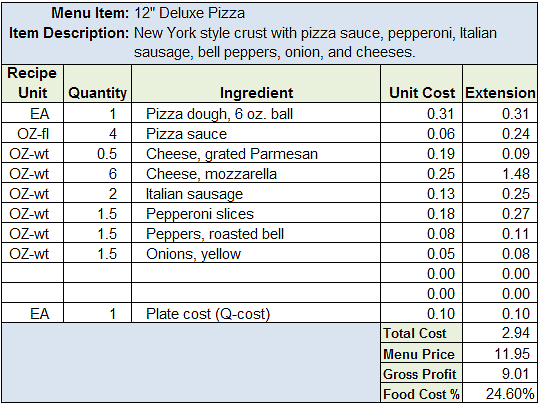
Next, create a menu costing sheet similar to the one illustrated below. Using the inventory listing, record to the menu costing form the quantity and cost of each ingredient used. Add the total cost of all ingredients used to arrive at the menu cost.
Menu Costing Sheet
To Continue Learning