






Article
New Year, New Compliance Challenges: Upcoming Changes to the Dual Jobs and 80/20 Rules and Their Effect on the Tip Credit
The business and trade press has extensively covered the changes to the so-called Department of Labor (DOL) "dual-jobs" and "80/20" tip credit rules that go into effect on December 31, 2021. And if you've been following this issue, the hospitality industry has pushed back aggressively at the new rule. If you have the patience and time to review the exact language of the final rule in the federal register, you can find it at:
The so-called "final rule" might be only the beginning of a new chapter in restaurant labor management. In this article, we explore what it means to your independent restaurant and how you might navigate compliance.
You will find, buried within its 44 three-column pages, the list of commenters that oppose the changes on behalf of employers. They include the American Hotel and Lodging Association, the Chamber of Commerce, the National Federation of Independent Businesses, the Restaurant Law Center and National Restaurant Association, several state restaurant and lodging associations, and many small business owners.
In spite of aggressive industry opposition, the changes appear unavoidable and unassailable -- at least under the current administration. "The hospitality industry has provided considerable criticism of the Final Rule, however, the DOL has been careful to recognize industry input and has provided the DOL's rebuttal to its critics as part of the new regulations. This may make it more difficult to contest the Final Rule in any court challenge." says Peter Spanos, 45-years' experienced partner in the labor and employment practice group at Taylor English Duma, LLP, an Atlanta-headquarters law firm.
As Spanos explains, the dual jobs and 80/20 rules are not exactly a sea change. In fact, they are decades' old under the Fair Labor Standards Act (FLSA). Still, the recent DOL modifications impose what many employers view as onerous compliance burdens on businesses that take the tip credit for tipped employees.
For the near future, it appears the industry will have to live with these changes, although it is conceivable the rules language could be challenged when alleged violations are brought before the court. In this article, we will not only review the final rule, but the pros and cons of measures operators might take to adapt to them.
A Little History
Let's start with the basics. As you likely know, the Fair Labor Standards Act (FLSA) allows employers to pay their employees less than the standard minimum wage as long as the employee earns enough tips to make up the difference. The federal minimum wage for tipped employees is $2.13 per hour compared to $7.25 per hour for other employees. In that case, the tip credit is the difference or, specifically, $5.12. States are also allowed to set their own minimum wage and tipped minimum wage, and in fact, many have minimums that are higher than those of the federal government.
The changes to the rule do not affect operators in states that have eliminated the tip credit. These include Alaska, California, Guam, Minnesota, Montana, Nevada, Oregon and Washington. In addition, operators that have eliminated tipping for front-of-the-house staff in favor of imposing a "service charge" do not have to be concerned.
As noted, the rules have a relatively long history. The 1988 DOL "Field Operators Handbook" (FOH) stated the federal regulations permit the taking of the tip credit for time spent in duties related to the tipped occupation, even though such duties are not by themselves directed at producing tips (i.e., maintenance and preparatory or closing activities), "if those duties are 'incidental' and 'generally assigned'" to tipped employees. The FOH identified such duties to include "waiter/waitress, who spends some time cleaning and setting tables, making coffee, and occasionally washing dishes or glasses."
The handbook also referenced the 80/20 Rule, declaring the DOL required employers to pay tipped employees the full minimum wage, rather than the lower tipped wage if an employee spends more than 20% of their time performing allegedly non-tipped duties.
Concerned over the trend of class-action suits for FLSA violations amid growing opposition to the tip credit, in 2018, The National Restaurant Association's Restaurant Law Center and the Texas Restaurant Association filed a lawsuit to enjoin the DOL from its beefed-up enforcement of the 80/20 rule to restrict, among other things, the restaurant employer from using a tip credit for side work, including cleaning, prepping stations, and cleaning.
The DOL, as do all federal agencies, reports to the executive branch. In December 2020, President Trump issued a final rule dispensing with the longstanding "80/20" tip credit rule -- whereby an employer was only required to pay a tipped-employee the full minimum wage rate for non-tip producing work if the employee spent in excess of 20% of their workweek performing such work.
As with many other agency rulings, the matter became somewhat of a political football. Under the Biden administration, the DOL withdrew the Trump-era rule and finalized its proposed rule with respect to tipped employees who perform multiple job duties for the same employer.
The Three Categories
The final rule divides a tipped employee's work into three categories declaring it part of a "functional test to determine when a tipped employee is engaged in their tipped occupation because they are performing work of the tipped occupation, and therefore the employer may take a tip credit against its minimum wage obligations."
- Tip-producing work. This is work that "provides service to customers for which tipped employees receive tips."
- Directly supporting work. This is work performed in preparation of or to otherwise assist tip-producing customer service work, it may be paid at a tip credit rate, but only if the work is not performed for a "substantial amount of time." A "substantial amount of time" is defined as either (1) more than 30 continuous minutes; or (2) more than 20% of the hours in the workweek for which the employer has taken a tip credit.
- Work that is not part of a tipped occupation. Any time spent in the third category (tasks not part of the tipped occupation) must be compensated at full minimum wage.
At first blush, the new rule's organization of duties seems clear, particularly in its definition of what constitutes a "substantial amount of time." The rule explains the 20% calculation on needs to be done once a week.
The challenge, however, is tracking "directly supporting" work. Hospitality -- and foodservice in particular -- is a dynamic environment. Regardless of the type of work in which they are engaged, tipped service staff move from task to task to do what is necessary to create a positive guest experience.

The final rule provides a list of activities that fall under each category for servers, bussers and bartenders. The rule also notes the list is not exhaustive, but certainly gives a good picture of the kinds of work you will need to track to avoid service staff exceeding the 20 percent.
As a hospitality professional, you might have heard the old adage "if you have time to lean, you have time to clean." Well, cleaning dining rooms or bathrooms is clearly defined in the final rule as "not part of tipped occupation." Moreover, there is no leeway in this category. If the task is not tip producing, then the employer must pay the employee full minimum wage for that time.
"The restaurant is forced to separately track that work," says Spanos. "I don't know how that could be done, unless you hire additional people to perform work that the DOL does not consider tip producing or break up directly supporting work into chunks that can be easily accounted for to avoid become excessive under the new rule," he says, adding, "the DOL doesn't think it is hard to divide the server's or bartender's day into discrete chunks of time."
Chris Tripoli, a veteran hospitality business consultant, disagrees with the DOL, particularly in the case of independent operators. Tripoli has served as an expert witness in a number of cases involving alleged FLSA violations. "Independent operators don't have the resources to track and report the time employees spend performing tip producing and directly supporting work with pinpoint accuracy," he says. "It can put them at a great disadvantage when defending violation claims."
Spanos concurs with Tripoli on the challenges faced by independent operators. "Maybe the big chains and brands can do this." He also notes the impact of the rule will vary state to state, depending on the minimum wage. Regardless of the size and sophistication of the business, says Spanos, "In general, the rule could decrease the efficiency of the operations and increase the costs to operators without providing any better service to the customer."
Ambiguities in the New Rule's Language
The final rule includes language that provides examples of how the DOL believes restaurant work should be categorized. Daniel B. Boatright, managing shareholder of the Kansas City office of the law firm Littler Mendelson PC converted this guidance into a graph. You may read Boatright's article on the final rule at:
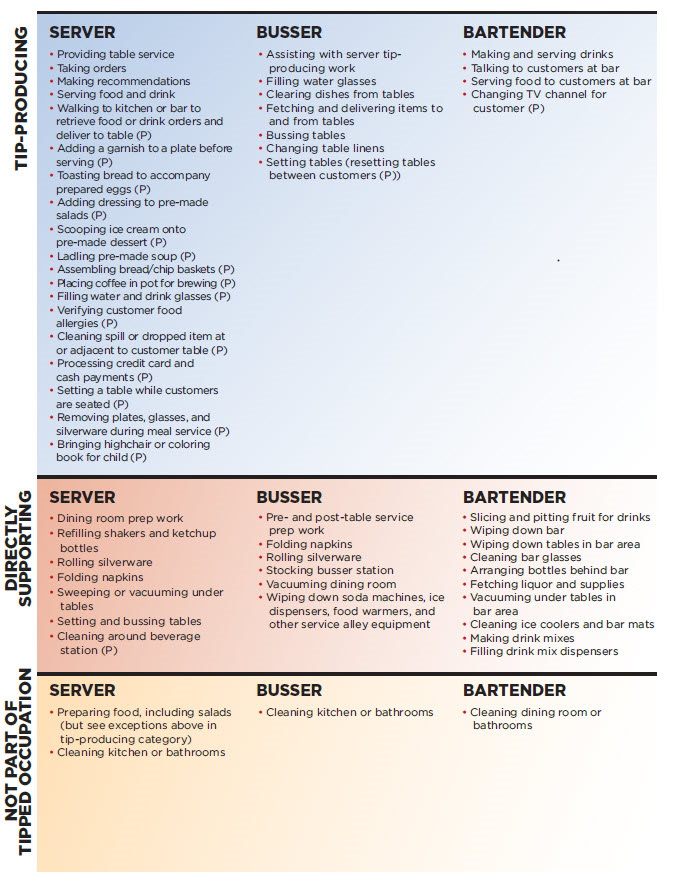
As Boatright notes in his article, "some of the items in the 'directly supporting' category are elevated to the tip-producing category if performed in response to a specific customer request. For example, a bartender who retrieves a particular type of beer from the storeroom to satisfy a customer request is performing tip-producing work, but if the bartender simply retrieves beer to restock for future orders the work is only "directly supporting." Similarly, a bartender who cleans bar glasses or implements to make a drink to fulfill a specific customer order is engaged in tip-producing work."
Boatright also points out the inconsistency in how the DOL treats food preparation, noting, "The preamble and final rule state that a tipped employee cannot perform any food preparation, and that includes making salads. However, the preamble states that "a server's tip-producing table service may include some work performed in the kitchen." These are only two examples of ambiguities that could challenge compliance. From his experience as an expert witness, Tripoli has found FLSA litigation often gets down to a struggle to translate the language of the rules to the operational realities of hospitality.
What's Next
FLSA violation claims are often initiated by employees. According to the DOL, employers who willfully or repeatedly violate the minimum wage or overtime pay requirements are subject to a civil money penalty of up to $1,000 for each such violation. A violation is willful when the employer either knew or showed reckless disregard for whether its conduct was prohibited by the FLSA.
The degree to which the rule will foment litigation is yet to be seen; however, as noted above, the compliance challenges are significant. Less certain is how the court will interpret and apply the language to specific situations. Federal courts have sided with defendants when a regulation at issue was ambiguous and the defendant's construction of it was reasonable.
As noted, a number of states have eliminated the tip credit. Again, one may only speculate if other states will follow suit in the wake of this regulation. The disadvantage of eliminating the tip credit is clear: It increases the cost of labor at time when the cost of labor is increasing. The advantages of not taking the tip credit include uncomplicating tip pool sharing. January 2021, the DOL's wage and hour division now allows an employer that does not take a tip credit to institute a nontraditional tip pool that includes employees in both tipped and non-tipped occupations, with the exception of managers and supervisors.
Some operators have eliminated tipping completely, and instead add service charges to the guest's bill. Several years ago, celebrated restaurateur Danny Meyer announced that the full-service restaurants in his Union Square Hospitality Group would do away with tipping. Other operators followed suit, and Meyer's proclamation attracted the attention of the restaurant trade and general media which underscored how deeply embedded restaurant tipping is in American culture.
No-tipping is not a new phenomenon, certainly for fast-casual concepts. Many full-service concepts eliminate tipping in favor of service charges, particularly for large parties and banquets. No tipping across the board for full-service restaurants is a much bigger deal. The potential obstacles to this approach include making it more difficult to hire quality servers. In many fine dining operations, a good server can make several hundred dollars a shift in tips, and receive the money at the end-of-the-evening tip out. Service charges become part of non-tipped wages. Moreover, tax authorities treat service like any other revenue and it is subject to sales tax.
John Buchanan is a veteran executive with the Lettuce Entertain You Enterprises restaurant group, currently comprising 120 or more restaurants mainly located in the Chicago metropolitan area. Currently president, Lettuce Consulting Group, Buchanan weighed in on the future of the tip credit and ways for all concepts, large and small, to navigate the new rules.
The tip credit has come under scrutiny by pro-labor advocates for a number of years. Buchanan is an advocate of fair wages and treating restaurant workers well. That said, the call for the elimination of the tip credit might be a misplaced sentiment, noting the Fair Standards Labor Act was designed to protect workers from dishonest and unscrupulous employers.
Says Buchanan, "Historically, Lettuce has always favored keeping the tip credit with the idea we are going to take you, the server, and put you in business for yourself." The tip credit makes the tipping model affordable for operators, he adds, noting he believes tipping creates "a huge incentive for service staff to work harder to create a positive work experience."
Is tipping automatic today? In other words, do guests tip regardless of the level of service? Buchanan believes that might be true, but only to a limit. "Receipts offer guests suggested tips based on certain percentages. While many guests might automatically tip at 15%, excellent servers might inspire tips of 20% and higher." Over a year, the difference in income can be significant.
Adopting a Compliance Strategy
Of course, the most obvious approach is to attempt to comply with the new rule. Efforts to adapt might include assigning non-tip producing work to specialized employees, and asking service staff to track their directly supporting work carefully.
Buchanan believes restaurants can comply with limits on "directly supporting" tasks with planning and systems. "I believe the smarter operators are going to monitor the activity with time-motion studies," he says, explaining, "let's say you know server-side work is doing 50 roll ups prior to a shift. You determine how long that takes and you make sure they are not assigned to more than can be accomplished in 30 minutes and without exceeding the 20-percent of hours worked limit for the week."
He suggests creating a list of all directly supporting work assigned in the restaurant and applying this approach. It would serve as evidence the operator compliance with the rules.
"I know that some operators say they or their managers don't have the time for this kind of planning, but I don't believe it," he says, adding, "particularly in this environment when you need to monitor your labor carefully to maximize productivity."
Indeed, with the cost of labor increasing and complications created by the final rule, one can anticipate operators sharpening their proverbial pencils to determine how to reduce the number of staff needed on any shift to an absolute minimum. While this is the end of this article, it likely is only the beginning of the story. How operators deal with the final rule is likely to be an ongoing topic of coverage for the hospitality trade press.
Editor's note: This article was written originally for HotelExecutive.com, with additional content added specifically for independent restaurant operators for publication in Restaurant Startup & Growth. As hospitality trade journalists producing management best-practices content, we appreciate other publications' interest in our expertise and contribute, whenever possible, to educate operators across industry sectors and media platforms.
John Buchanan on the Corner Booth Podcast
John Buchanan joined Chicago-based Lettuce Entertain You Enterprises 42 years ago, and his continuing respect for the organization assures him he made a good choice. In his successful career with the 120-unit restaurant group, John progressed from unit management to systems development to establishing the company's Human Resource department, and then creating the Lettuce Entertain You Consulting company.
Says John, "Overtime laws, regulations, and consumer trends change; however, a corporate culture based on the importance of fairness and purpose doesn't. While people visit restaurants for food and beverage, they return because the company has paid attention to staff selection, training, and ongoing development. It is a people business." John is bullish on today's independent restaurant marketing, and feels operators can set themselves apart with passion, creativity and adaptability. Through years of consulting, he has found that many concept founders do not become the best leaders; however, John feels that as long as owners remain open to professional development, they can be coached. In John's office hangs a sign with the message: Think you can? Think you can't? Either way you are right."
-

Webinar/Podcast
John Buchanan with Lettuce Entertain You Enterprises
Join hosts Chris Tripoli and Barry Shuster and their guests for a podcast for anyone who is starting a restaurant business, growing an independent restaurant business, or dreaming about starting an independent restaurant business. Learn from successful restaurateurs who share their stories WHY they ...