






Article
Five Restaurant Repair and Maintenance Best Practices
According to the National Restaurant Association's Restaurant Industry Operations Report, most restaurants spend anywhere from just below 1 percent to upward of 2.5 percent of sales annually for repair and maintenance of equipment, building and grounds.
Considering that the annual sales volumes for all respondents ranged from less than $500,000 to more than $2 million a year, we're talking about a difference of tens of thousands of dollars in annual R&M (repair and maintenance) expenditures.
You might ask how there can be such a disparity in the amount one restaurant spends on R&M versus that of another. Naturally, the size and style of the restaurant accounts for much of the difference. Larger restaurants need more HVAC (heating, ventilating and air conditioning), kitchen and bar equipment, and have more building and grounds to upkeep. But this isn't the only difference.
A closer review shows huge variations amid restaurants of similar size and service styles as well. Certainly it stands to reason that as a restaurant ages, the need to repair or maintain equipment increases. Even so, after factoring in all the obvious reasons that can account for the huge differences in R&M expenditures, we are still left with the fact that some restaurants control their expenditures in this area better than others.
Proactive vs. Reactive Management
As a 30-year veteran of the restaurant industry, I'm not surprised by these disparities. I've found that the reason for cost differences among restaurants is typically the same reason there are differences in the quality of product and service: management.
Good, sensible restaurant management requires a proactive rather than a reactive approach. Proactive managers anticipate the demands of guests and needs of their staff. They don't wait for problems to occur; they avoid them. So it is with controlling repair and maintenance costs. Good managers won't wait for something to break - an occurrence that usually happens at a time when it most likely affects service -- rather, they establish best practices for keeping their equipment, building and grounds in good working order.
Best practices include the establishment of daily, weekly and monthly tasks that are performed day in and day out to ensure consistency -- and profits. This article discusses some of the best practices that can help keep your R&M costs under control.
Best Practice No. 1: Proper Cleaning
Improper cleaning methods -- or lack of cleaning -- account for the majority of restaurant equipment failures. Manufacturers usually include their recommended cleaning and care procedures in the owner's manual. But that doesn't mean their recommendations are heeded.
For instance, too frequently employees will find ways to clean kitchen equipment faster rather than properly. Hoses and pressure washers oftentimes take the place of good-old fashioned elbow grease. While this may be a good solution for cleaning the back dock, it can be a huge factor in the number of equipment repairs you'll encounter.
I asked Raleigh Trotter, founder of Trotter Repair Services in Houston, what one piece of advice he could offer restaurateurs that would help them lower their equipment repair costs. His reply: "Take the hoses out of the kitchen."
"I've seen cooks use a garden hose to spray everything from ovens to floors," Trotter says. "What most people don't realize is that water is one of the most corrosive substances there is. While a lot of equipment has stainless steel on the surface, burners, wiring compartments and the underside of equipment don't have the same protection. The deflective spray from a hose tends to penetrate areas not intended for exposure to water."
Trotter says that if restaurant equipment were properly cleaned, he probably wouldn't have as much work, though he's not complaining. Trotter suggests using scrub brushes and degreaser on external surfaces rather than spraying water. He also mentions using a manufacturer-approved oven cleaner for ovens and a wire brush on burners.
The message is this: If you are serious about prolonging the life of your equipment, then clean it properly.
Best Practice No. 2: Proper Training
All too often, restaurant personnel severely lack proper knowledge of the equipment they use each day. True, in this high-tech era in which we now live, the complexity of some equipment has increased to create "foolproof" systems for the cooks.
Whether it's programmable fryers, high-tech combination ovens or sophisticated video order systems, equipment designers have put more emphasis on ease of use rather than comprehension on how it works. Nevertheless, managers and kitchen managers should have a working knowledge of how each piece of equipment works, how to properly clean it, and how to perform periodic maintenance.
Common sense plays a role when it comes to preserving equipment longevity. For instance, refrigeration equipment relies on airflow to remove heat. Staff should be trained not to stack boxes so close that it could cut off air circulation, causing the compressor to work harder.
Likewise, staff should be instructed to turn off equipment not in use. Or, let's say you use a charbroiler that has two or more burners. Turning off one side during slow times not only saves unnecessary wear and tear, it also reduces the amount of heat in the kitchen. This practice can help keep your utilities cost down as well.
Paul Bergeron, partner and franchisee of Joey's Seafood & Grill in Winter Haven, Florida, provides his managers with the proper tools to troubleshoot problems as they occur. New managers are provided basic "how to" information in the training materials they receive. "It includes how to maintain equipment to provide longer use," Bergerson says.
"It also gives an overview of the common parts (coils, condensers, etc.), and how to maintain and clean. Also included are potential corrective issues they can check before calling a repairperson. This is all given to them during the training phase to assess their comprehension level in this area. It gives them, and us, more confidence about how repair issues will be handled when they are running the store."
Trotter agrees. "Managers [who] have a better understanding of how equipment works and are willing to troubleshoot a problem over the phone can usually avoid the delay and expense of an on-site service call. Sometimes, the remedy to correcting a problem can be as simple as turning a gas valve back on or even plugging a cord in.
"But if the manager or cook [who] is calling doesn't know what a quick-disconnect is, then I have to charge them $100 to send my man over to do what they could have done in about 30 seconds."
Managers should know the location of breaker panels -- each breaker should be clearly marked -- gas shutoff valves, quick disconnects, water shutoff valves and grease traps.
Whether you're still in the startup phase or even if you've been open for years, it's never too late to improve your training. Even a simple addendum containing copies or excerpts from your equipment manuals can prove to be valuable training material that can save you money in the long run.
Best Practice No. 3: Preventive Maintenance
One of the best ways to avoid surprise equipment failures is to have a preventive maintenance (PM) program. PM contracts can be obtained for everything from refrigeration to kitchen equipment to POS systems. Costs and scope of services vary dramatically. Some PM contracts are designed more like "extended warranty policies," intended to cover the full cost of parts and labor if the equipment fails. Naturally, this type of contract can get quite expensive because the service company must set the price high enough to cover their costs -- and their profits.
On the other hand, the most effective PM contracts are not structured to cover the cost of the service call or parts needed. Rather, a true "preventive maintenance" plan is one in which the service company is scheduled to perform periodic maintenance intended to replace worn parts and keep equipment running in good condition, thereby minimizing the untimely and sometimes very costly bigger failures.
The chart below shows some general periodic maintenance that should be done on an assortment of refrigeration and other equipment commonly found in restaurants. Typically, refrigeration and HVAC account for the lion's share of repairs and maintenance. Service usually requires a licensed technician or company to perform the work. Maintaining proper refrigerant levels, replacing worn fan belts, and keeping fan motor bearings greased and running smoothly will prolong the life of your refrigeration equipment, possibly saving you from having to buy a new compressor or condensing unit.
Keeping refrigeration coils clean and the cooling fins undamaged is also important to keeping your refrigerators and air conditioning units at peak performance. Trotter says that many operators can accomplish this simply by providing a soft bristled brush and hot, soapy water to your trained staff.
Selecting the right vendor for the work needed is another way to keep your repair bills down. Bergeron says that his store tries to identify at least three repair companies for each kind of service needed, according to their areas of expertise. "We listed them in the order which we would like them to be called, but it gives managers more confidence when they have a backup vendor (or two) to call if the first vendor is not available and service is needed ASAP."
Bergeron also wants to know each vendor's billing policy. For instance, here are some of the things they try to find out about the vendors:
- Is there a trip charge associated with the visit?
- Is there a minimum amount of hours that they bill for a service call?
- When does the billing begin; is it upon arrival at your restaurant or is it upon departure from their location?
- What is the billing rate? Ask to see examples of a service invoice for another customer.
- What are the weekend and overtime billing rates?
- Do they have preventive maintenance plans they can quote you?
Not all PM tasks require service companies. In fact, there are several things that can be accomplished by your staff with a little training and guidance. For instance, steamers, coffee makers, combination ovens, and other equipment that heat water are prone to heavy calcium buildup on heating elements and probes, significantly increasing the heating time and affecting performance. To prevent this, most manufacturers recommend periodic descaling, a process that flushes the hot water compartment with a deliming agent. Properly instructed, your kitchen staff can perform this task.
Staff can also be trained to periodically change most water filters. In fact, the use of water filters is recommended by manufacturers for any equipment that uses water. However, if you don't change them, the benefits of using filters are lost.
Best Practice No. 4: Keep an R&M Log
Bergeron stresses the importance of recording equipment repairs. His managers use an R&M History Form (see below) to record the details of each service call. Rather than combing through old invoices, having a history available for quick reference makes it less troublesome to see if a particular piece of equipment has developed a pattern of service issues. This helps an operator to better evaluate problematic equipment on whether to keep repairing it or consider replacing it.
The startup restaurateur can benefit by completing a form for each new piece of equipment that is purchased. On it, record where the item was purchased, the manufacturer, the model and serial number, and the warranty provisions. This way, they can avoid paying for service calls that may be covered by warranty, provided they adhere to the warranty provisions such as using a designated service company that is authorized to do warranty work.
Trotter says that this practice can be very beneficial to a technician when making a service call. "Our technicians carry thousands of dollars of replacement parts on their trucks, but they can't have everything," Trotter says. "It helps a lot if the customer is able to provide us with that information so we don't spend so much time looking into warranty or getting the correct parts."
The form is also helpful for managers to know which repair company to call when equipment breaks. As managers change, it's unfeasible to expect the new manager to know which repair company repairs what equipment. But if they have a well-maintained logbook that contains this information for every piece of equipment, then the training curve is simplified by just showing them how to use it.
Best Practice No. 5: Prompt Action
Proactive managers oftentimes use a manager's logbook, commonly referred to in the industry as the "red book," to record a daily journal of events and to convey messages to the next manager shift. If an R&M issue occurs during the dinner shift, then the closing manager should leave a detailed note for the next day's opening manager. The opening manager's first order of business each day is to look at the logbook to see what issues require immediate action.
Trotter points out that managers sometimes wait too long to repair equipment by resorting to jury-rigging rather than calling a service company. When I asked him why, he said that a lot of managers don't want to spend the money on repairs because it affects their bonus. If they're at the end of their bonus period, they sometimes try to stretch out the use until the new period begins.
"What they don't realize," Trotter says, "is that by procrastinating, it usually leads to higher repair bills." He offers an example, with some advice for restaurants with gas-fired equipment, whenever the temperature control knob becomes harder to turn on and off. "Don't let your cooks resort to pulling off the knobs and then using channel locks to turn the control valves. If the control becomes hard to turn, call your equipment company. For the price of a service call, they can grease all of the controls with high-temp lubricant every six months or so. Once they start using the pliers to turn the knobs then eventually the whole control valve will need to be replaced, adding a couple hundred dollars to the repair ticket."
Likewise, if your walk-in cooler temperature begins running a little higher than normal, you'd be wise to have your refrigeration company check it out sooner rather than later. Running a system that is low on refrigerant causes the compressor to work harder, shortening the compressor's life span, and increasing electricity usage.
Cracked gaskets on refrigeration and oven doors need prompt attention, too. Waiting until they are completely deteriorated only prolongs the inevitable, which is that they need to be replaced. And by waiting, cold or heat continually escapes, resulting in higher utility costs.
Bergeron doesn't like to wait on repairs, either. He gives his managers a three-point checklist they use to determine the urgency for needed repairs; listed below in order of priority: 1) It is broken and affects guest or employee safety. 2) It is broken and affects guest service. 3) The manager needs or wants to have it fixed.
Plan for the Best, Prepare for the Worst
It's easy to preach the benefits of maintaining your equipment. Sometimes though, reality tosses a curveball to operators. They know they need to make repairs but they just don't have the cash flow to always get it done promptly.
Surprise equipment failures -- especially the ones that are accompanied by expensive repair tickets -- tend to happen when cash flow is at its lowest; like right before payday. This is why it is important for operators to increase the annual R&M budget as equipment gets older.
It's also wise to create an emergency fund. Let's say you budget 1.5 percent of your sales each month for R&M. If you don't spend it one month, then set that money aside. You'll probably need it at some point later down the road to cover one of those surprise breakdowns.
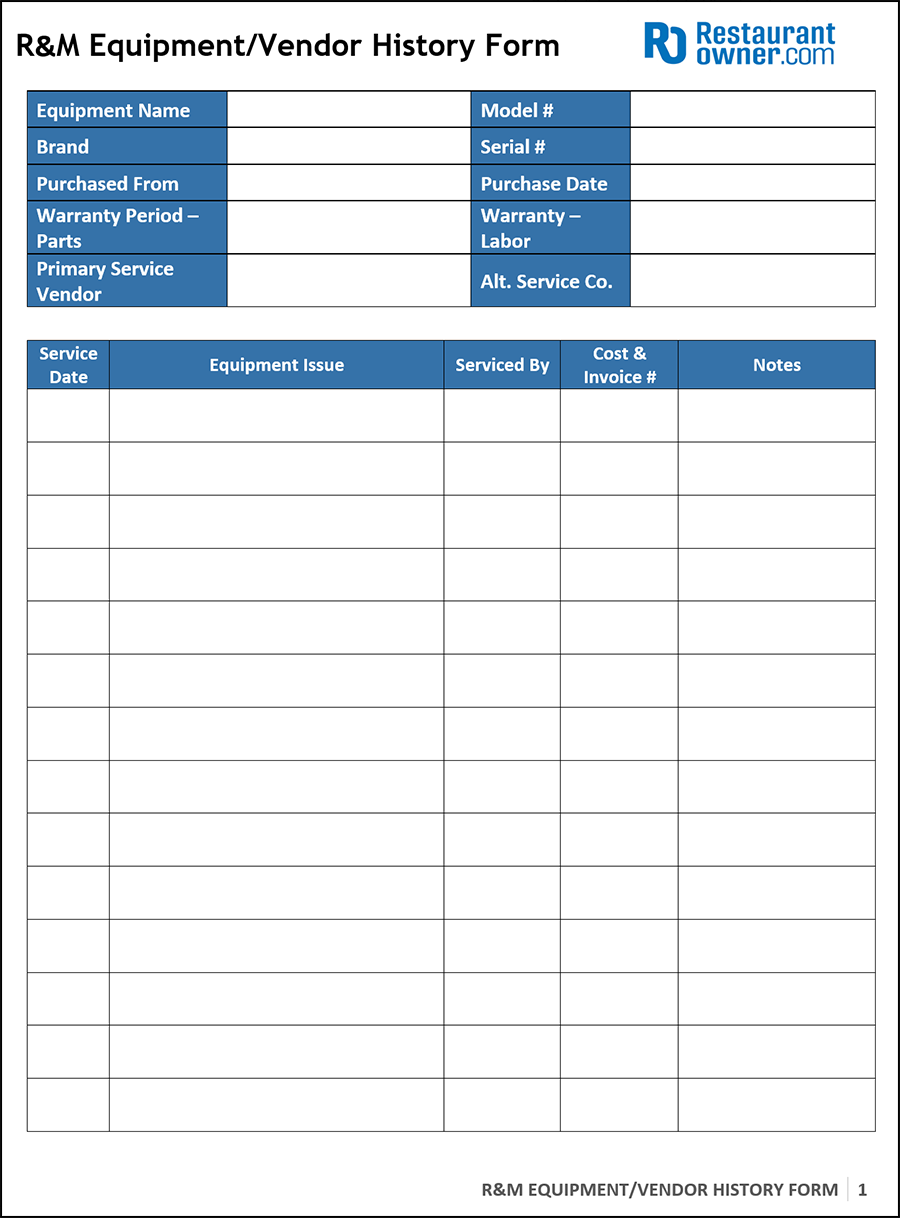
Use an R&M Equipment Vendor History Form to record the details of each service call. Rather than combing through old invoices, having a history available for quick reference helps detect if a particular piece of equipment has a pattern of service issues. This helps an operator to better evaluate problematic equipment and whether to keep repairing it or replace it.
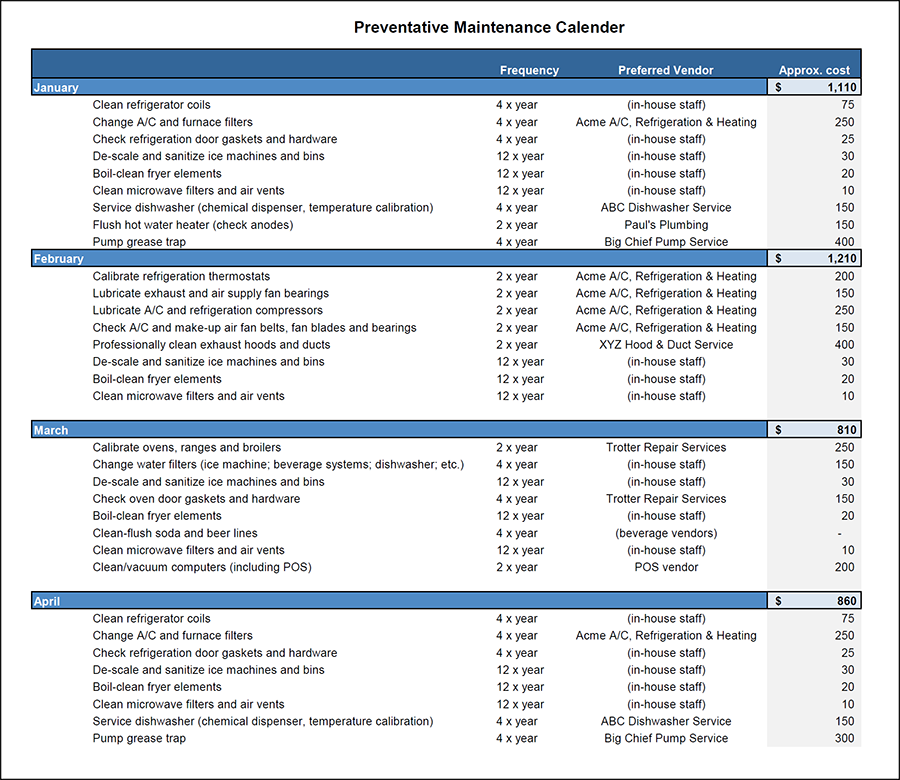
This chart shows some general periodic maintenance that should be done on an assortment of refrigeration and other equipment commonly found in restaurants.