






Article
How Social Media Can Rev Up Your Digital Hospitality
While COVID-19 vaccines are rolling out, the digital-first trends ushered in by the pandemic are not going away. McKinsey Digital, an arm of global management consulting firm McKinsey and Associates, estimates in eight weeks -- when the pandemic first spread through New York -- the country moved forward five years with regards to digital adoption.
Amid a pandemic that altered what the concept of hospitality could look like, the concept of digital hospitality proved to be transformative. Restaurants that had mastered (or quickly pivoted to) digital hospitality had a better year than those who started from scratch with tasks like building out a website, initiating delivery or online ordering, and cultivating community connection over social media.
What does this mean for restaurants? Even when dining rooms are open at full capacity, customers will want food delivered. And they'll be looking to digital-first to learn about your concept, explore the menu, and make dining decisions. Brush up on what digital hospitality really means when applied to the restaurant industry and learn how busy operators make time to nurture relationships through social media.
Just Another Techy Buzzword?
When asked why busy operators should care about yet another techy buzzword, Matt Vannini, CEO and Founder of RASI, Restaurant Accounting Services Inc, looks no further than last year: "When the pandemic hit, most operators were immediately faced with the loss of their businesses. You're staring at an empty restaurant with a government mandate that says you can't serve people, so how were you going to create a virtual brand with the cuisine [you served]?" he asks.
While many concepts did takeout or delivery, dine-in was the majority driver of business for decades -- and overnight, it wasn't accessible. Digital hospitality, to Vannini, means leverag- ing technology tools to foster an enjoyable experience "for your guests, your team members, and your profit."
Successful restaurant operators like Cali Comfort BBQ operator Shawn Walchef, who Vannini admires, used technology and social media to define the brand's differentials, attract guests, and set expectations. Then they delivered on those expectations to boost bottom lines.
"Shoot it, post it, don't overthink it," he recommends. "Selfie" videos (which show an operator talking to the phone) or clips showing staff cooking food are two video types he recommends. After doing thirty days of video, operators will "have their own feedback loop" to evaluate what subjects resonated with customers and tweak their approach.
Vannini notes that it's still the essentials that drive repeat visits -- elements every operator should get right but often do not. "People are staying with those brands that deliver hot food hot," he quips. In other words, remember that digital hospitality only takes you so far, and at the end of the day, you've still got to put out a quality product, no matter where guests are eating it.
Walchef defines the concept more bluntly: "Customer service is bulls**t and any person who's owned a res- taurant can tell you what hospitality truly is, it's how you make someone feel. Anticipating needs and making people want to come back separates great brands from brands you forget."
This might seem abstract when thinking digitally, but ultimately relates to the customer perception of a restaurant (which they are getting online) and how your concept meets or exceeds those perceptions with every order.
Why Digital Hospitality Matters
Digital hospitality can do many things: define a brand through storytelling, reach new audiences, remind loyal fans what your concept can do for them, create signature experiences for your audience in a time when on-premises may not be fully available, and help operators take control of the business narrative.

Social posts are good for the bottom-line. Vannini explains with an example of a time he posted about a menu item called Copper River salmon, a specialty that he knew would entice locals. "Your regular guests are going to come in" to get a favorite local dish at a great price. "You see guest counts and guest check averages [and] you know the post and those two [variables] tie together."
Just by posting about these sorts of specials, operators can make guests excited to stop in or order takeaway without spending anything -- though paying to promote a post can, of course, extend its reach.
These days, diners and local media are hungry for feel-good stories -- especially stories about restaurants, which are positioned as "vital to the fabric of society" in a way they weren't before, says Walchef. Newspaper reporters want to connect with restaurant operators, either to profile a success or help a struggling local business. And they're looking for these stories online. If you aren't telling your story on social media -- on your personal page as well as a brand page, Walchef emphasizes -- you're missing out on bigger media opportunities that can really drive business.
Faced with one more thing to do, an operator's first instinct might be to outsource social media posting -- say, to a young person who's handy with technology. There is a place for that: "The minute you say 'I have no idea what I'm doing' and you spend half an hour on YouTube trying to figure it out," it's time to get help, says Vannini. But operators shouldn't underestimate the importance of knowing how to do it themselves, even if they need to be taught initially.
Walchef had an early lesson on the importance of DIY social media in 2008, when he hoped to drive traffic to his then-new barbecue restaurant by hosting UFC and boxing pay per view events. They needed to get guests in seats to recoup their expenses. Walchef knew San Diego locals were Googling where they could watch the fight.
He needed his restaurant to show up when someone searched for a term like "UFC fight night San Diego" or the math wouldn't work. But he didn't know how to update his website with the right keyword so it'd be in- dexed by Google and appear in search results. Walchef remembers paying the person running his website to add the event, so they'd show up in search. "I would have to email them [then] it would take two days to get the info published on the website, then I would look and it wasn't correct, then by that time I'm losing SEO [search engine optimization]," he explains, he felt it was too late. A techy friend taught him WordPress and he never looked back.
Now, Walchef isn't just a restaurant operator, he has a media company and puts out a podcast on digital hospi- tality. He evangelizes the concept of being his own media company -- of knowing how to do it all yourself because at the end of the day no one is going to work harder for your restaurant than you will. Good ideas are available if you look. Walchef borrowed a "Four-P's of Digital Storytelling" and social media marketing approach from Elizabeth olson, marketing director for Chook Charcoal Chicken's ("Chook"), a Colorado-based multi-unit Australian rotisserie chicken concept.
The Four P's of Social Media
"Digital storytelling is the greatest asset a business owner has, and you have to invest in that asset," says Walchef. The best way to do that, he suggests, is to use the smartphone (which he terms "the greatest gift we all have") and master a simple, repeatable formula -- one he calls the Four P's.
Plan. Planning helps operators maximize limited time and be consistent with their messaging -- and consistency is key to setting guest expectations. Walchef hypes the idea of "north star content." As it suggests, north star content is a reliable fixed navigation point that people come to expect from your concept -- something that defines the brand that a customer can look forward to consuming on a regular basis, like once a week. His north star is the weekly podcast, but another operator might use a newsletter or a weekly hashtag campaign. The idea is to find something that can be the cornerstone of the brand.
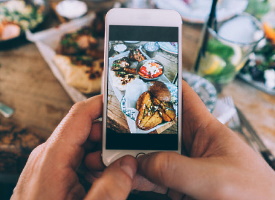
There are a couple of don'ts that should guide planning. Not having a cohesive strategy is a mistake most people make, says Vannini. Posting polarizing content, or treating social as a place to rant, is another. "Stay in your lane and post about [ways to bring] people together, even when separated," Vannini recommends.
In brainstorming ideas of what to post, it's helpful to think about what works well for other concepts in the market. Walchef suggests looking up geo-specific hashtags to get an idea of what other local operators are posting and what hashtags they're using for posts. Also called geo-tagging, it is the process of attaching location information in the form of geographical metadata to digital media like web sites, videos and photographs. This exercise can bring clarity and inspiration for operators who don't know what kind of content to put out there.
Social media channels push out content based on algorithms, so having an idea of what kind of content is "hot" right now will help operators get more views by leveraging the algorithm. Native video content is huge right now, so Walchef recommends using video for digital storytelling.
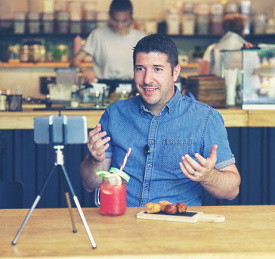
Produce. Walchef and Nicholson both encourage operators to try out different techniques and learn what works by doing. Walchef suggests operators set a goal of publishing one video a day for 30 days. "Shoot it, post it, don't overthink it," he recommends. "Selfie" videos (which show an operator talking to the phone) or clips showing staff cooking food are two video types he recommends. After doing thirty days of video, operators will "have their own feedback loop" to evaluate what subjects resonated with customers and tweak their approach.
Nicholson recalls a recent conversation with a friend who was afraid of creating the perfect post before putting it out. "Get your feet wet right away," she encourages. It takes time for a brand to find its voice and engage customers and, like Walchef, she believes that the best way to find out what works with an audience is to try a few things and evaluate. "The more [you] know [your audience], the more you're visible [and] the better your post will perform."
Publish. This is the scary part, Walchef admits. "People don't like how they look or sound, or they think they need to edit when ultimately, [it's empowering] once you hit publish." Don't self-censor, he encourages.
Nicholson adds one caveat: before posting, she suggests making sure the post reinforces that sense of uniqueness that is essential to digital hospitality. "Are you posting just to post or [is there a story to tell]?" she asks.
Promote. Social media only works when people interact with it, thus the final P is for promote. Paying to promote a post can help new audiences discover it, as can using hashtags specific to the cuisine or location.
Walchef knows operators can be nervous about posting restaurant stuff on their personal feed, but encourages sharing content on both personal and business feeds. "If your friends are so turned off by people talking about your restaurant on your personal profile, they're not really your friends." Once content is promoted, it's time to plan the next set of posts, then produce, publish and promote again.
Hospitality Through Social Media
Nicholson knows firsthand how time-consuming it can be to engage customers via social while attending to other tasks. "I'm also working in the [restaurant] a lot of the time [in addition to] marketing and human resources," she says. She makes it all work with smart planning, savvy repurposing of content, and technology resources that streamline her effort.
Nicholson says that Chook mainly uses Instagram, but cross-publishes their Instagram posts on Facebook to capture a second audience. She'll expand on the caption or theme of a published Instagram post for the newsletter. To illustrate with an example, Nicholson said she'd just been snowshoeing and took a quarter chicken with her for a campaign they're running on "taking it up to the mountains for the weekend."
Their Instagram is intended to be uplifting, so she shot "a goofy post" of the chicken juxtaposed with her snowshoes for Instagram Stories. "Next week, I'll use the same photo and a similar story to remind people, before they leave town for the weekend, to order their Chook. [And then I'll] push out a newsletter that will focus on how great our packages are, how you don't need to go to the grocery store when you get to town, [and] here are our instructions for reheating."
It's the same consistent story of taking a chicken up to the mountains to avoid having to cook, executed at varying levels of detail for different target audiences. The consistency teaches people what to expect (awesome takeaway meals), shows them how to engage with the brand (tag us in your goofy photos and we might share them) and drive sales with encouragement to put in an order.
"Customer service is bulls**t and any person who's owned a restaurant can tell you what hospitality truly is, it's how you make someone feel. Anticipating needs and making people want to come back separates great brands from brands you forget.
Repetition of this sort helps build a brand and set those customer expectations that are so critical to digital hospitality. As Nicholson says, "the more people see Chook and our face, brand and food, the more likely they are to come in."
"As much as we like to believe our followers on Instagram are really engaged every time they see a post, they're not the same followers on Facebook or on our newsletters," she adds. In other words, operators should reuse images without guilt; due to audience differentials (and algorithms that limit the scope of posts), few people will see a duplicate.
To further reduce the time load of social media engagement, Nicholson plans everything in advance using a themed approach. She'll look at a big calendar and take note of holidays, school breaks, and other important events. She'll factor in known busy or slow times and think about "what brings people in and what keeps people at home and how can we reach out to them." From this big picture thinking, she comes up with themes. Noticing that lunch sales were down, she decided to promote Chook's lunch offerings.
Nicholson keeps track of the themes on a calendar, where she also connects social media marketing to the restaurant's other marketing initiatives, including newsletters, "so it's a directed push we're working on." Here again, repetition sets customers' expectations, formulates that crisp brand identity, drives sales, and builds consistency.
"Once I have the themes set up, I see what photos I already have available that fit into that," Nicholson says. Stock photos are another option, as is user-generated content (essentially, photos posted by fans under brand-specific hashtags, which you can then republish). Nicholson recalls a Thanksgiving (or "Chooksgiving") campaign that engaged customers and generated a lot of user-generated content. By using their feed as an example, Nicholson was able to show people what type of images to shoot and what tags to use when posting.
User-generated content "reaches a ton more people than me posting as a brand," she explains. People are likely to trust or follow on social media people they know, so customer use of the brand hashtag can broaden the audience exponentially.
"People love seeing photos of people," Nicholson explains. These days in particular, "so many folks are getting on social media to have a connection." She'll often share photos of staff to humanize the concept, and notes that COVID-19 has provided an interesting opportunity to show more back-of-house content than she might have been able to do previously. Other operators might do well with video content that acts as a "virtual tasting or cooking class" and "builds the dine-in connection," recording something on Zoom and then republishing it on YouTube or IGTV (Instagram TV), for instance.
Nicholson works with the free version of Buffer to develop ten posts at a time, which she says "is the perfect amount I can plan out, especially during COVID-19 times" when things can change quickly, so that drafted content is outdated before it's published. She'll select the photos and write up captions using a voice that captures that fun and playful vibe they're aiming for with Chook's social media presence.
Double the Following
Nicholson doubled Chook's following in the two months after the pandemic hit. She says she intentionally wanted to bring "relief and sense of fun when there was so much chaos in the world," and focused on a clear message in the wake of the pandemic. "The underlying message we're always sending is 'we've got this.' When you're eating a Chook, you don't have to worry about dinner." The restaurant started as a fast-casual concept where you could pop in for a grilled chicken and sides to-go or eat-in-house, inspired by the Australian neighborhood chicken shops that co-founder Adam Schlegel remembered from his youth. They pivoted to 100 percent takeaway in the pandemic, but their origin story gave Nicholson that north star -- a central message about Chook's role in a pandemic life.
Once a week, Nicholson will dig into the analytics on Instagram to understand what's resonating with customers. She's less interested in demographics, location or age of the audience and wants to know what people shared, clicked on, or liked. Knowing "what content people are going online to look for" helps operators "build brand voice" and tailor upcoming posts to give the audience more of what they indicated they liked.
SOCIAL MEDIA RESOURCES TO LEVEL UP DIGITAL HOSPITALITY
Finding Photos to Share: There's no better way to tell your brand's story than with photos that bring it to life, like images of your food, your space, or your staff. But stock photos can be a great shortcut.
Free stock photo libraries include:
Unsplash:https://unsplash.com
Pixabay: https://pixabay.com
Pexels: https://www.pexels.com
Scheduling Social Posts: Create content on your time and schedule it when it's likeliest to get
views with help from scheduling tools with free and paid plans such as:
Buffer: https://buffer.com
Hootsuite: https://www.hootsuite.com
Later: https://later.com/
Diving Deeper on Digital Hospitality: Walchef's eponymous podcast on the topic is a treasure
chest of resources. The following episodes are especially recommended:
• #55: Curiosity and Storytelling | Business Coaching Call with David Meltzer: https://calibbq.media/curiosity-story-telling-business-coaching-call-david-meltzer-dh055/
• #63: Brand Building in a New Era: https://calibbq.media/brand-building-in-2020-shawn-walchef-on-the-cantore-show-dh063/
• #68: How to Turn Your Business into a Media Company: https://calibbq.media/how-to-turn-business-into-media-company-full-comp-podcast-dh068/