







Article
How to Measure and Boost Your Social Media Marketing Performance
A customer subscribes to your email newsletter and opens the email you send. They then comment on your Facebook post and like an Instagram image. They navigate from Instagram to your website, where they put in an order for a special and pick it up onsite Friday night, and when your host asks how they heard about the deal, they say "online."
Do you know if your social media marketing is building guest traffic and sales? And which platforms and messages are performing best? These are good questions and that's why, in this article, we cover the basics of measuring and driving results from your social media campaign.
What does online mean in this scenario? Is it your website where they placed the order? The social media networks where they engaged with your feed? Or the email newsletter where they first heard about the special?
Determining which marketing channel to credit with the sale is known as attribution. And attribution matters for busy operators who sometimes feel like they need to be everywhere their audience is to stay top of mind. Understand how attribution is measured, how to tell if organic social media posts and paid social media ads are driving sales, and the social media etiquette faux pas that could be reducing your audience engagement.
How to Tell Whether Social Media is Driving Sales
Social media marketing spending increased 74 percent from February 2020 to June 2020, according to the Harvard Business Review "The CMO Survey". For restaurant operators who were struggling to attract customers amid a changing landscape of regulations, it was easier to advertise their updated hours, menus or special guidelines on Instagram or Facebook than to update their website, a task many operators outsource.
Keep Learning... Harvard Business Review
CMOs: Adapt Your Social Media Strategy for a Post-Pandemic World
https://hbr.org/2021/01/cmos-adapt-your-social-media-strategy-for-a-post-pandemic-world
There's no question that social media engages customers, and that it helped operators pivot their service model in challenging times. But answering the question of "how much" is difficult given that social media websites have limited analytics, leaving operators to pay for the next-level information they need to really unpack the relationship between sales and customer behavior.
Shawn Walchef, who operates Cali Comfort BBQ and hosts the Digital Hospitality podcast, digs into his social media analytics during a weekly meeting, much the same way other operators look at weekly prime cost. "Any time you do something new you have to understand what the numbers are, [and] they don't mean anything unless you look at numbers week over week," he says.
Walchef starts with the analytics built into the social media channels. Walchef also encourages operators to set up email notifications, so they're sent reports containing key insights. "Knowing how many visitors we had allows us to track trends and identify what might be a driver," he says.
Dan Hooper, co-founder at YesMore drinks marketing agency and YesMore Content, with locations in London and Los Angeles, acknowledges the analytics data inside the social media apps can be "basic." Built-in analytics will show you some key takeaways relating to post reach (how many people saw a post) and engagement (how many people interacted with a post), "but many will give you a time limit to access the data and only go as far as telling you how many links clicks you have had," he says. "The more beneficial data is, annoyingly, in the paid-for third-party analytics tools."
Hooper notes that operators who are running paid ads on Facebook and Instagram will have access to Facebook Ads Manager, which he says is "very useful" in analyzing ad performance. He also recommends installing Facebook Pixel on the restaurant's website if paid Facebook ads are part of your digital marketing strategy. Facebook Pixel tracks users that navigate from a Facebook ad to your website and take an action.
Keep Learning... Facebook Pixel
Facebook for Business: Measure, Optimize and Retarget with Facebook Ads
https://www.facebook.com/business/learn/facebook-ads-pixel
"You can run ads that drive people to book tables and then the pixel will notify Ads Manager when the ad has successfully booked a table," Hooper explains. By gathering information about the users who convert (book a table in this example), Facebook Pixel 'learns' which audience segments are likeliest to convert. It then tailors your ads to the most receptive audience in a process called conversion optimization. Over time, you'll ideally get a better ROI (return on investment) on your Facebook ad spending, because the ads are going to those who are most likely to convert.
Paying for ads buys access to the best analytics tools and the most accurate insights, but not every operator can (or wants to). If you're not doing paid social media ads, Hooper says "you need to be much more anecdotal" in terms of figuring out a correlation between social media posts and sales.
He suggests two experiments you can run to get better data if you're only doing organic social media posts. One, you can post to social media and pause all other marketing efforts for a set period of time, then evaluate sales. If sales dropped, it would suggest another marketing method is a big driver. If you don't want to stop everything else, Hooper suggests putting out a special promo code just on social media. By tracking promo code redemption, you can understand how many sales in a given time period come from social media. By using separate promo codes for every social media platform, you can compare the ROI of, say, Facebook to Instagram to determine how to allocate your digital marketing budget.
Something Hooper doesn't recommend is analyzing the relationship between sales and social media likes or comments. It's difficult to connect these comments to increased sales or more frequent visits, and parsing the data is largely a waste of time.
Link shorteners like Bitly (www.bitly.com) or Ow.ly (built into the Hootsuite social media scheduler) provide another way to analyze the performance of organic social posts. Link shorteners work by converting a lengthy URL from your website into a shortened URL, aka shortlink. The shortlink is cleaner and offers analytics. You can see how many times a link has been shared, where your links have been shared, how many clicks links have received, or the time and date of click throughs to determine your best time to post. While Bitly's paying customers can create branded shortlinks, customers on the free plan receive alphanumeric links. These are less elegant if you're sharing shortlinks in social videos when brand reinforcement is key, but they'll work fine for analytics purposes.
Digital marketing expert Neil Patel explains how link shorteners like Bitly can help business owners gain insight into which links shared on social media are clicked by users. When you know what posts are the most popular, you can recycle the variables to determine what specifically drove the click. Was it the style of image? The phrasing of a CTA? A discount code? Marketing copy that told a good story? Testing these different variables by, say, repeating a call to action (or "CTA") across a series of posts, can help you determine the real driver of audience interest. Sure, not every click leads to a sale, but the posts that generate the most interest are working powerfully for your brand. Accordingly, there's something about those posts that's making a strong impression -- and determining what it is can help you leverage greater sales from posts that resonate strongly with your audience. Adding Bitly links to every post takes time but can deliver impressive results. Patel mentions that headphone brand Beats by Dre increased website traffic by 34 percent by using Bitly to track and evaluate their social media content.
Social Media Etiquette
Walchef and Hooper stress that if you're only on social media to make sales, you're doing it wrong. "Don't just dive straight in and sell, sell, sell. You end up coming across like a used car salesperson desperately trying to sell them anything," says Hooper. Hooper encourages operators to remember three things: "social media is an incredibly powerful tool for reaching new people, engaging them (warming them up), and then converting them into bookings/sales later." Building relationships one post at a time leads to greater revenue -- even if a customer doesn't buy when they're targeted by a Facebook ad.
Hooper reminds operators that a CTA should have a single desired action to generate a clear and consistent result. If a post asks for customers to leave a comment, it should not also ask for them to reserve a take-home meal kit or book a table.
The frequency of posting is just as important, if not more so, than having the right call to action at the bottom of a post. As Walchef says, "What leads people to buy isn't always a strong CTA, it can be the repetition of seeing [your restaurant] pop up on their feed... just by posting frequently, you'll increase the chance that users see your posts and start to think about their next visit."
Strong storytelling is likewise key to sales, as Walchef mentioned in the digital hospitality feature. "People buy because they relate to the local mom-and-pop running the store down the street. [It's] the way they make you feel." By creating regular content that incorporates storytelling, you'll keep your brand "top of mind," and that will naturally lead to more sales.
It never hurts to go for the ask, but Walchef recommends a 20-percent ratio where one out of every five social media posts asks for a sale. "If you ask every time, it's going to get annoying and people aren't going to want to engage with that," he adds.
Tips for Getting More Sales from Social Media
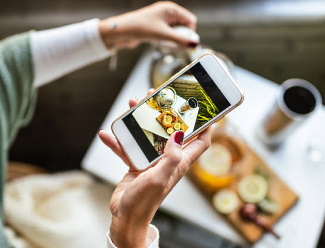
Attributing sales to social media is helpful if you want to evaluate your marketing spending and the return on investment. If the numbers aren't what you'd hoped to see, how can you encourage sales without getting too "salesy" (and turning off users in the process)? Hooper says he started YesMoreContent.com as a time-saving way to make it easy for alcohol brands to get relevant, beautiful content. He recommends operators "be beautiful with your social media, capturing gorgeous shots of your products, people and restaurant. And then be sociable with your social media, speaking to your audiences like actual humans in a conversational and relaxed tone of voice."
A typical user is flicking through social media as a quick break. Maybe they're eating lunch or watching television before bed. "What we recommend is to create content that makes people want to stop scrolling," says Walchef. An attractive image combined with a caption that's on-brand and in your voice (whether witty or wise) can do the trick. Both Walchef and Hooper recommend starting small. You'll avoid burnout from overcommitment, and you'll have a smaller stage on which to figure out what type of content is most effective for motivating sales.
"These social channels are hungry beasts and will chew through your content and your time if you spread yourself too thinly," says Hooper, who recommends growing one social media channel at a time. "Start with one, test, learn, optimize and then add another when you've locked down the process."
The more you learn about social media marketing best practices, the more comfortable you'll feel with your strategy. There's no one best way to generate sales with social media, Hooper notes, but as long as you track metrics, learn from the data, and optimize, you'll be well-positioned to reap the community and financial benefits of a solid social media presence.
Hooper also suggests that operators be flexible and creative in thinking about where to start. "Is it Instagram? Or should it be a review site or your own Google/Apple Maps listing first?"
If you have multiple locations, don't assume that every location needs to have its own social media feed. "Imagine if Starbucks did it," Hooper says, to illustrate how what seems like a good idea at the outset becomes unsustainable with growth. With one account for all your locations, you'll be able to save money, save time, and focus on keeping the quality of content high.
Social media schedulers allow you to create content and schedule it for the peak times, so you don't need to pause your day to post when engagement is highest.
Social media scheduler Sprout Social has a list of the best times of day to post on different social media platforms. Globally, the highest user engagement on Facebook occurs from Tuesday through Friday, from 9 a.m. to 2 p.m. Instagram user engagement is high Monday through Friday during the same 9-2 window, with best engagement on Wednesday at 11 a.m. and Friday from 10-11 a.m. For weekend engagement, think Twitter, which sees more solid engagement on Sunday than the other channels. The best times to post on Twitter are Wednesday and Friday mornings from 9-11 a.m.
An old-school restaurant operator is typically used to spending through a mailer or newspaper ad, where the metrics are based off a half-million people [who] listen [but] those aren't trackable and you don't know if somebody listened. What digital marketing does is allow you to directly understand where the conversion happens. If I run an ad with a CTA to order wings, I'll get cost-per-click metrics. [If I spend] $100 for a 4-day ad, and I get four people that order, I paid for the ad.
By timing your posts to go out when social media users are most active, you can increase the number of eyeballs on your content (and perhaps sales). Using the right hashtags to make your content discoverable to new audiences can further increase the amount of people who see your posts. The more people who see your posts, the more people who know your concept; timing it right can increase your followers or fans, which gives you a bigger target audience for sales.
"This isn't what you want to hear, but if you want to get more social media sales, plan to pay for it," Walchef says, "In order to stand out in the clutter (and Instagram is very hard to grow organically), we advocate paid ads to directly show up in somebody's feed." He notes that people tend to be reluctant to spend money on social media ads, or want the ads to prove their efficacy first, but they don't hold traditional marketing outlets to the same standards. "An old-school restaurant operator is typically used to spending through a mailer or newspaper ad, where the metrics are based off a half-million people [who] listen [but] those aren't trackable and you don't know if somebody listened. What digital marketing does is allow you to directly understand where the conversion happens. If I run an ad with a CTA to order wings, I'll get cost-per-click metrics. [If I spend] $100 for a 4-day ad, and I get four people that order, I paid for the ad."
Flipping a mindset to understand how social media advertising delivers value, as compared with that traditional mailer, can help you agree to give it a try if you haven't yet. Walchef recommends setting a budget and knowing ahead of time where you want to spend the money, whether it's on Facebook, Instagram, or YelpConnect, which he recommends as a great (and unexpected) way to connect socially with customers.
Measure What's Important to Your Concept
Be sure to center your goals when thinking about your social media strategy and ad spend. Not every restaurant needs to measure the same metric, and sales may not always be the best goal. For a new concept, it might be more important to focus on growing the number of fans or followers so posts are reaching a large target audience. If you're hoping to leverage email marketing for impressive gift card sales, growing your newsletter base might be a goal. Seeing sales within the bigger picture will help you understand the different levers of social media and how to use the platforms to build sales without accidentally undercutting your intentions.