







Article
How to Manage Online Customer Reviews
These days, it seems like everyone is a food critic. Once thought of as a job for professionals requiring years of experience and palette refinery, not to mention a thorough understanding of restaurants and cooking, the craft of "critiquing" has boiled down to, in some cases, a few online sentences denoting a restaurant as good, great, bad or really bad.
For better or for worse, Yelp, TripAdvisor, Zagat and other online user review sites are here to stay, just as social media continues to become the wave of the future. While mainly restaurant critics still find themselves gainfully employed, the millions of posts by the everyday consumer can overrun their words.
Looking at it another way, online user review sites are more than just a soapbox for some and a wannabe restaurant critic space for others. Their larger purpose has been, in a very positive way, to serve as a digital suggestion box for restaurant management. These sites are the eyes and ears of the most important person in the restaurant world: the guest. In short, if you're doing everything right -- your food is good, your service is top-notch, your house is clean and running smoothly -- you'll get great reviews. If you're getting negative reviews, it's time to take a closer look at your restaurant.
Critical Feedback
That's how Nick Sarillo, owner of Nick's Pizza & Pub in Crystal Lake and Elgin, Illinois, sees it. Yelp in particular has helped Sarillo gather, manage and respond to customer feedback to both improve his operation and maintain a dialogue with his customers.
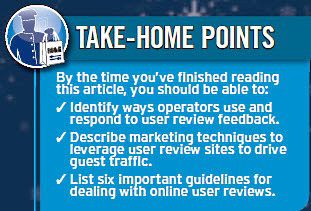
"When a review comes into Yelp, even if I'm in the middle of a shift and I have my phone with me I can pull up the review and share it in real time with my staff," he says. That goes for both critical and positive feedback, he says. Sharing the positive feedback, in particular, helps boost morale among servers and kitchen staff. "I try to get back to the poster within 24 hours, sometimes it's 48 hours with Yelp," he says. "I try to respond whether the review is positive or negative. I feel that if they took the time and energy to give feedback I should respond."
Sarillo is also a heavy user of Facebook, where guests can also post reviews of the restaurant. However, he says, Facebook tends to be overwhelmingly positive in the nature of the reviews; likely because you're either a "fan" of the restaurant on Facebook, or you're not. See "In Review: Online User Review Sites" below for descriptions of other online user review sites on the market.
While Sarillo chooses to respond to all reviews on Yelp, both the positive and the negative, many restaurants simply try to focus on only the negative reviews to save what little extra time and energy they have. Such is the case for John Wilkerson, general manager of The Purple Pig in Chicago.
"I check Yelp every week on Saturdays," Wilkerson says. "Anything that contributes to a pattern of sorts, whether it's multiple diners saying a dish was too salty or others mentioning a horrific experience with a hostess or bartender, I tend to try to find a finite pattern to something that's wrong and approach those issues right away."
Looking for patterns, rather than blindly replying to any negative review helps create your own internal filtering system. Yelp already filters out "spam" reviews as much as possible, and restaurants can flag certain posts and users if they believe they've been a subject of fraud, according to Wilkerson and Sarillo.
"Yelp has its own system of filtering [that will] look into the user if the review doesn't seem legitimate," Wilkerson says. Disgruntled employees, spammers and other hackers have been known to post unfairly-attacking reviews. There have even been posts made by users who were nowhere near the city where the restaurant attacked is located.
Respond to Reviewers
Responding to harsh criticism online is not unlike pre-Internet days when restaurateurs had to approach disgruntled customers tableside. The main difference is, online review sites make it easier for customers to attack harder and customers to respond less stressfully -- both are essentially "anonymous," and online versus in-person certainly offers a less confrontational situation.

After first determining if a review seems legitimate or not, the consensus among restaurant operators quoted in this article is that when it comes to legitimate complaints, responding privately to the user, rather than publicly to all users online, is the best, and safest, way to go.
Frank Stefano, owner of Stefano's Golden Baked Hams in Yorba Linda, California, and Abel Woldemichael of Muzita Abyssinian Bistro in San Diego fall into that group, with Wilkerson and Sarillo.
"I think as a restaurateur it's important you don't get into a contest or a battle with the reviewers," Stefano says. "You can't go back and forth with them or take anything personally. You can't live and die by a review. I suggest looking at them and taking them for what it's worth and being honest with yourself -- if there was a mistake at the restaurant, take care of it.
For Woldemichael, he'll send a public message for positive reviews, but not for negative reviews. "We're a new restaurant, about 2 1/2 years old, and we're an ethnic restaurant so we definitely have our challenges on paper," he says. "We are lucky to have mostly positive reviews. If it's negative, I'll respond privately but I publicly praise the people that write great reviews."
Rarely does his Ethiopian/Eritrean bistro get really negative reviews on Yelp, but if he were to have a pattern of complaints regarding a problem for which he was at fault, Woldemichael says in that case he would apologize in a public manner. In one such case, a couple had come in for Valentine's Day and felt that they didn't have a good experience, likely due to the fact the restaurant was overbooked that night, one of the busiest days for restaurants in the year.
"I replied to them in a private message and apologized and said, 'Hey, that should not have happened -- it does sometimes, but shouldn't,'" Woldemichael says. "Then I asked if they wanted to 'redo' their Valentine's Day on us. They accepted and I publicly apologized for the experience. Afterward, they changed their review to five stars and now they are regular customers."
When sending a private message to the user, first, introduce yourself, say thank you for posting the review, and then simply apologize. Many operators, including Woldemichael, Wilkerson, Sarillo and Stefano, choose at that point to invite the guest back into the restaurant for a second chance. Usually that means a complimentary meal, or at the very least a strong discount, but it's important to note that anything other than a complimentary meal has the potential to cause more tension and rejection.
Above all, honesty with yourself and the guest is the best policy. Take the suggestion as a potential for im improvement or analysis.
"We had a guest once complain that we skimped on the cheese on his pizza," Sarillo says. "If I brought that back to my staff they'd say defensively, 'we aren't skimping on the cheese.' So instead I brought the complaint to the staff's at attention more generally and reminded them about our recipe, tention which is 9 ounces of quality cheese made from whole milk; that's the way we've done it for 35 years."
Sarillo also weighed out some of the cheese going onto the pizza to make certain there wasn't a problem. Though he didn't find any skimping, this could be an opportunity to ask staff to weigh the cheese before adding it to the pizza -- an extra step to be sure, but a way to improve consistency and quality. And, instead of arguing with the guest as to whether he was right or wrong, Sarillo instead invited the customer back in. It worked; days later the reviewer changed his review.
In addition to inviting a guest back in, as a secondary note, some owners or managers will provide their contact information, or ask the guest to notify them when they come in the restaurant for that second chance. Doing so not only makes the guest feel welcome, it also alerts the restaurant and staff to pay extra attention and care to that guest or guests so they'll leave with a better impression.
At that point, and at any point, don't solicit reviews, Woldemichael says. "I want the reviews to be legitimate," he says. Not to mention doing it looks like desperation and it also invites potential for negative criticism.
Advertising and Marketing
Yelp, TripAdvisor, Facebook -- it's all advertising. And it's cheap. Better yet, Yelp in particular offers free tracking services to listed businesses to measure the number and nature of reviews and track patterns, including customer demographics.
OpenTable, an online reservation management service that recently added a user review section to its site, offers similar marketing and Web-analytics tools. The tools gather data about the customers who make the reservations and visit the restaurant, including the times and days of the week on which the diners visited. The restaurant can then use that information to track patterns of peak activity as well as slow periods to determine special menus, promotions, pricing and more.
Cross-marketing techniques also help strengthen a restaurant's online presence. Woldemichael displays links to the bistro's Facebook and Yelp profiles prominently on his website. He has even filtered in comments from Yelp directly onto the site as well, adding an extra level of open dialogue and transparency.
And while it's not necessary to pay for advertising on Yelp, Stefano has found doing so gave his already thriving business an extra boost.
"There is definitely a correlation between advertising and the number of hits we get online," he says. Through this system on Yelp, the restaurant pays for a set number of clicks -- or pages -- such as purchasing 10 ad clicks for $10 a piece. "They do a good job of tracking your progress and using graphs and other ways to show whether you're getting click-throughs on the ads or not. The paid advertising route was a natural progression for us, but I only do it a couple of times a year and not for very long." You don't want to overdo it, in other words. But advertising in such a way can help during slow periods, such as after the winter holidays.
Attracting Traffic and Tourists
Many travelers use sites like Yelp and TripAdvisor as a virtual concierge service -- a way to research good places to eat and things to do in a new city.
Stefano says he found success as a destination spot for great deli sandwiches and paninis among visitors, thanks to online user review sites and, in particular, Yelp. "We had people coming in and say they found us on Yelp," he says. "We've really grown from that." Wilkerson agrees. "Yelp is a great way to showcase great service and food -- if you have it -- to tourists," Wilkerson says.
The Purple Pig is considered among local and even national foodies as a hotspot right now, but its location on The Magnificent Mile overlooking the Chicago River has also made the restaurant a successful tourist destination.
"Yelp and TripAdvisor contribute a great deal to our foot traffic," Wilkerson says. "We have come up with an estimated number that's about 50 percent tourists. Most of the reviewers on Yelp are not local residents; they're people from Kansas, Minnesota, even Kentucky, and we're averaging a four-star rating, which is great. We take the information we get from them very seriously. Whether someone is from rural Iowa or downtown Chicago, the consumer is telling you what you need to do and how you can get better."
While Wilkerson's team won't compromise the integrity of the menu or wine list -- it has received accolades from media outlets around the country -- they will look more closely at complaints about service and overall operations.
"We don't take reservations, so we get beat up a lot on the wait time, and we're a lively place so people complain about the place being too loud sometimes," Wilkerson says, noting that those things are hard to control. "You have to pick and choose what the complaint is about. But, if 20 people tell us the music is too loud, chances are the music is too loud so we'll turn it down. One time we had a reviewer -- in real time -- post a review complaining about someone turning the lights up before last call at 2 a.m. Now, no one is turning the lights up before 2 a.m."
Don't Take it Personally
Don't take comments too personally; rather, take them as constructive criticism. And, remain calm; don't be defensive.
That's the name of the game when it comes to Yelp and other online user review sites. "Whether we like it or not … this is the wave of the future," Wilkerson says. Sarillo agrees. "Whether we like it or not, the guests' perception is their reality," he says. "It doesn't matter if you've done everything right and the forces of evil seem to be against you or there's a full moon. If they feel they've had a bad experience, they had a bad experience. It really holds us accountable to ramp up our game."
In Review:
Online User Review Sites
- City-Specific Sites. Many city-specific entertainment sites allow users to post comments about places they've visited, including restaurants. Chicago-based Metromix.com, which has outlets in other cities nationwide, is an example of this type of site.
- Gayot. Paid-for, experienced writers review restaurants in major cities throughout the country. It's geared mainly toward travelers.
- OpenTable. An online reservation management service that has since added a review function allowing guests to rate and comment on their dining experiences after the fact. TripAdvisor. Online travel guide, search engine and comments/review forum geared toward travelers and tourists.
- Urbanspoon. A search engine for restaurants around the country, this site shows printed reviews by local media as well as user reviews.
- Yelp. Considered the most popular and widely used user review site, this San Francisco-based "Yellow Pages" for stores, restaurants and more started in 2004 and allowed the community to post comments about any and all types of businesses, including restaurants. Yelp also offers software, data tracking and advertising solutions for listed businesses.
- Zagat. Considered the first consumer-rated review guide in printed, hand-held book form, this company has since gone online. Diners, however, must first qualify to become raters, which have helped elevate the legitimacy of the reviews on the site compared with other more open-access sites. Also posts current menus and maintains a running blog.
Words of Wisdom:
Six Tips for Dealing With Online User Reviews
- Don't ignore online user reviews; they're here to stay. So if you are involved with them, be proactive. Check the reviews, good and bad.
- Share both positive feedback as well as legitimate critiques with staff and management to boost employee morale and make improvements to your food, service and/or operation.
- Choose to respond to positive and/or negative reviews, but when responding to negative reviews, respond privately rather than publicly. This helps prevent an online "battle" where you're the center of attention.
- One idea is to invite negative reviewers back in for a complimentary visit if it was their first experience at the restaurant. Or offer them a discount to come back. Then, follow up with them after the fact.
- Contact Yelp or the user review company if you believe you have been the victim of spam, fraud or unfairly attacked by a disgruntled employee. Sometimes reviews will be posted by users who aren't registered as having been even near the city where the restaurant they attacked is located.
- If you are listed on Yelp or other platforms, take advantage of the services they offer, such as tracking hits, and advertising solutions.