






Article
Animal House
Managing Furry Restaurant Patrons
We are an animal-loving nation. Forbes Advisor reports that, as of 2022, 44.5% of U.S. households own dogs, and 29% own cats. Furthermore, it reports that between 2016 and 2022, the percentage of U.S. households who own dogs increased by 6.1 percentage points, from 38.4% to 44.5%, while the percentage of households that own cats increased by four percentage points, from 25% to 29%.
Yelp searches using the “dogs allowed” filter jumped 58% between May 1, 2021 and May 1, 2023. Serving human guests in your concept is challenging enough. Their animal companions present additional hospitality and safety considerations.
The good news is federal and state regulations can guide you if you know where to look.
Learning Objectives:
By the time you've finished reading this article, you should be able to:
- Define “service animal” according to the Americans with Disabilities Act.
- Explain how to manage a guest whose animal is not adequately controlled.
- Identify sources of state and local regulations to guide permission of non-service animals on foodservice establishment premises.
Serving Those Who Serve
You have no obligation to allow animals on your premises unless they are “service animals” as defined by the Americans with Disabilities Act (ADA), Title III, which prohibits discrimination based on disability in the activities of places of public accommodations, which include restaurants.
Other species, including birds, chimpanzees, lizards, pigs, or snakes – anything other than dogs and miniature horses – are not considered service animals. Under the ADA, you are not required to allow them on your premises, regardless of what their owners claim is their purpose.
Until 2012, the U.S. Department of Justice (DOJ), which enforces the ADA, limited the definition of service animals to dogs. The DOJ has since expanded service animals to include miniature horses, which range in height from 24 inches to 34 inches measured to the shoulders and generally weigh between 70 and 100 pounds.) Restaurants must modify their policies to permit miniature horses where reasonable. I will discuss “reasonable” in more detail below.
Other species, including birds, chimpanzees, lizards, pigs, or snakes – anything other than dogs and miniature horses – are not considered service animals. Under the ADA, you are not required to allow them on your premises, regardless of what their owners claim is their purpose.
The DOJ provides clear guidance on ADA regulations regarding service animals (www.ADA.gov), but there are situations when the restaurant must make “judgment calls.” Before we dive deeper into the laws governing animals in restaurants, I will make the following recommendation. Restaurant managers and owners, not front-line staff, should assume the responsibility for familiarity with these rules, and their compliance and enforcement. Staff should not be asked to “police” guest behavior.
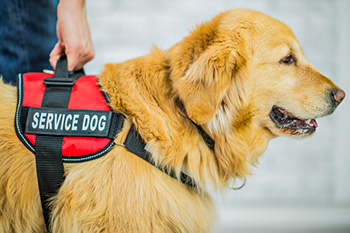
So, what is a service animal? Service animals are not always identifiable by a uniform when out in public. The ADA does not require that the animal wear special gear or have identification, such as a patch or vest. If a guest arrives with a dog or miniature horse at a restaurant that does not allow pets, it can present a management quandary.
Many of us are familiar with “seeing eye” dogs who guide people who are blind. Other tasks performed by service animals include alerting people who are deaf, pulling a wheelchair, protecting a person who is having a seizure, reminding a person to take prescribed medications, calming a person with post-traumatic stress disorder (PTSD) during an anxiety attack, or performing other duties.
In short, the work or task a dog has been trained to provide must be directly related to the person’s disability. Dogs and miniature horses whose sole function is to provide comfort or emotional support do not qualify as service animals under the ADA. The ADA makes a distinction between psychiatric service animals and emotional support animals.
If the dog has been trained to sense that an anxiety attack is about to happen and take a specific action to help avoid the attack or lessen its impact, that would qualify as a service animal. However, if the animal only provides comfort, that would not be considered a service animal under the ADA.
Service animals are not pets. Whether the service animal is a dog or a miniature horse, it must be trained to assist disabled owners. According to the DOJ, the manager on duty can ask the owner of the animal two questions:
- Is this dog or miniature horse a service animal required because of a disability?
- What work or task has this dog or miniature horse been trained to perform?
The manager may not ask what the disability is or information about its details. They may not ask for documentation, such as a license or papers as evidence that the dog or miniature horse is a service animal.
Other tricky situations might occur if the animal is out of control and the handler does not take effective action to control it or the dog is not housebroken. The DOJ considers these legitimate reasons to ask a guest that a service animal be removed. That said, the restaurant must offer the guest an opportunity to obtain goods or services without the animal’s presence. That might mean packing the food to be consumed off-premises.
There is no restriction on what dog breed a disabled individual can use as a service animal. The dog’s size must be appropriate to its task and must not interrupt the normal course of business. Like service dogs, service miniature horses should be housebroken and under the owner’s control.
Moreover, the restaurant should be able to accommodate the miniature horse’s type, size, and weight. It should not compromise legitimate requirements necessary for safe operations. If these requirements cannot be met, it could be a legitimate basis to exclude them.
What constitutes interrupting the normal course of business requires judgment? You might wonder what to do if other guests complain they are allergic to or fearful of dogs. According to the DOJ, these are not reasons to deny access or refuse service to people using service animals.
Other tricky situations might occur if the animal is out of control and the handler does not take effective action to control it or the dog is not housebroken. The DOJ considers these legitimate reasons to ask a guest that a service animal be removed. That said, the restaurant must offer the guest an opportunity to obtain goods or services without the animal’s presence. That might mean packing the food to be consumed off-premises.
In these situations, however, you may seat guests to give them adequate distance apart. That said, according to the ADA, people with disabilities who use service animals may not be isolated from other patrons, treated less favorably than other patrons, or charged fees that are not charged to other patrons without animals.
Certainly, a restaurant does not want to discriminate against guests with disabilities. Nor do you want your concept to be investigated and fined for improperly excluding a service animal from the premises. Penalties for violation of the ADA can be stiff and might include the complaining party’s lawyer fees, let alone the cost of defending a claim.
On the other hand, restaurateurs are not expected to tolerate disruption of operations or unsanitary conditions that could drive away business or create liability (discussed below). Hopefully, unreasonable disruption is clear-cut, based on anyone’s objective observation, such as an animal wandering and interrupting guests’ meals or interfering with service staff carrying out their jobs.
If there appears to be a legitimate reason to exclude a service dog or miniature horse from the premises, a prudent measure would be to document the action and the basis for the decision as business record evidence if a complaint is filed.
State and Local Regulations
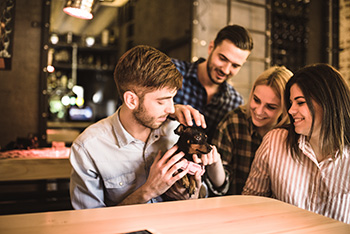
As noted, you are not required to allow animals on your premises unless they are bona fide service animals as defined by the ADA. Nevertheless, you might wish to permit guests to dine with their non-service animal pets to attract their patronage and be competitive with concepts that invite four-legged guests. In that case, you must reference governing state and local regulations for guidance.
Citing each of them is beyond the scope of this article. That said, Rebecca F. Wisch on behalf of the Michigan State University College of Law’s Animal Legal and Historical Center published a directory of state regulations in 2023, which appears to be accurate and comprehensive. Bear in mind, however, that statutes and regulations are subject to change.
According to Wisch, as of 2023, 23 states allow dogs in outdoor patio areas of restaurants by state law or through administrative regulation. Counties and municipalities may enact ordinances that govern these matters if they do not conflict with state law.
Having read several state regulations, I have noticed a few similarities that one might consider common sense. In North Carolina, my home state (where I teach and am licensed to practice law), the relevant administrative code (15A NCAC 18A) offers the following guidance:

Live animals are allowed in the following situations if the owner or operator does not permit animals to physically contact food, serving dishes, utensils, tableware, linens, unwrapped single-service and single-use articles or other food service items that may result in contamination of food or food-contact surfaces and does not permit animals to physically contact employees engaged in the preparation or handling of food:
- Fish or crustacea in aquariums or display tanks;
- Patrol dogs accompanying police or security officers in offices and dining, sales, and storage areas; and sentry dogs in outside fenced areas;
- Service animals accompanying persons with disabilities in areas that are not used for food preparation;
- Dogs (Canis lupus familiaris) and cats (Feliscatus) in outdoor dining areas; provided that dogs and cats are physically restrained, and do not pass through any indoor areas of the food establishment. Except for service animals described in Subparagraph (3) of this Paragraph, nothing in this Rule prohibits a food establishment from prohibiting dogs and cats in outdoor dining areas; and
- In areas that are not used for food preparation, storage, sales, display, or dining, in which there are caged animals or animals that are similarly confined, such as in a variety store that sells pets or a tourist park that displays animals.
Unpacking the language of this North Carolina and similar state regulations, we may read this as limiting non-service animal pets to cats and dogs in outdoor spaces, where they are restrained, not handled by restaurant staff, and kept away from food preparation areas. This means a separate outdoor entrance for animals so they do not have to pass through indoor dining areas.
As adorable as Fido might be, kitchen and service staff should not pet him. No food preparation should occur where animals are permitted, including mixing drinks, making guacamole tableside, etc.
You might find similar language in your state regulations, although depending on the state, they are more detailed. For example, New York public health law includes the following language (McKinney's Public Health Law § 1352-e):
- Companion dogs under the control of a person may be allowed in an outdoor dining area at a food service establishment if all of the following conditions are satisfied:
- the owner of the food facility elects to allow companion dogs in its outdoor dining area or a designated portion of it, and subject to any restrictions that the owner of the facility may establish;
- a separate outdoor entrance is present where companion dogs enter without going through the food establishment to reach the outdoor dining area and companion dogs are not allowed on chairs, benches, seats, or other fixtures;
- the outdoor dining area in which companion dogs are allowed is not used for food or drink preparation or the storage of utensils. A food employee may refill a beverage glass in the outdoor dining area from a pitcher or other container;
- food and water provided to companion dogs shall only be in single-use disposable containers;
- food employees are prohibited from having direct contact with companion dogs while on duty. A food employee who does have such prohibited direct contact shall wash his or her hands as required by law;
- the outdoor dining area is maintained clean. Surfaces that have been contaminated by dog excrement or other bodily fluids shall be cleaned and sanitized;
- the companion dog is on a leash or confined in a pet carrier and is under the control of the companion dog owner;
- there is reasonable signage indicating that companion dogs are allowed in the outdoor dining area or a designated portion of it. The signage shall state that restrictions on companion dogs do not apply to guide, hearing or service animals;
- the food facility owner ensures compliance with local ordinances related to sidewalks, public nuisance and sanitation; and
- such other control measures approved by the enforcement agency are complied with.
- This section shall not impair or diminish the right of an individual to be accompanied by an animal where otherwise permitted by law, including but not limited to the rights of people with disabilities using guide, hearing or service animals.
- For purposes of this section:
- “Food service establishment” shall mean any business which has areas, including outdoor seating areas, in which food is sold for on-premises consumption.
- “Companion dog” shall mean a domesticated dog accompanying an individual or owner for the purpose of companionship or convenience of such individual or owner, and shall not include guide, hearing or service dogs.
This New York law spells out what we might consider common-sense restaurant sanitation requirements. These include restricting animals from guest seating or on surfaces where food is served and eaten. The restaurant should provide owners with materials to immediately clean animal waste followed by a thorough cleaning. In addition, preparing outdoor areas for subsequent shifts would include a deep cleaning to remove hair and dander. You do not need a lawyer to tell you that dog hair drifting into a guest’s Cobb salad does nothing for the guest experience, let alone a concept’s reputation.
Liability
Guests have sued restaurants for injuries caused by other guests’ animals. In a 2015 New York lawsuit, plaintiff Sonya Hargro sued restaurant owner Scott Ross seeking damages for injuries she sustained from another guest’s dog bite. Matters such as these are typically governed by state common law and statutes.
The case went to the New York Court of Appeals (Hargro v. Ross, 21 N.Y.S.3d 520 (N.Y. App. Div. 2015). The appellate judges opined that Ross was not liable “under the theory of strict liability, in the absence of any evidence that the restaurant owner had actual or constructive knowledge that the dog had any vicious propensities.” In this case, strict liability means the dog owner bears legal responsibility for damages caused by their animal.
Thus, New York, like a majority of states, has “dog-bite” statutes that establish strict liability against the owner of a dog that injures another individual or, in some states, causes property damage. As noted, however, the court ruled that this defense to liability only applies if the owner does not know that the dog is vicious. This suggests that the restaurant management must intervene if an animal shows a propensity for viciousness. (Again, remember that state laws vary.)
This presents another tricky situation. While a guest might argue vigorously that their dog is “friendly,” animals can become agitated or threatened in new environments, particularly in a loud outdoor dining area with other animals. North Carolina regulations permit both cats and dogs in outdoor dining areas. (Editor’s note: “What could go wrong?”) Children are attracted to animals but often lack the experience and judgment of how to approach them. Even the most patient pet will bite if startled.
Of course, this sounds like legalistic doomsaying. Many concepts accommodate service and non-service animals without incident. Nevertheless, as lawyers are prone to say: “Everything is o.k. until it is not.”
When a guest’s animal becomes disruptive or, forbid, threatening, management likely has no choice but to ask the guest to remove the animal from the premises. How the manager chooses to spare the relationship with the guest (e.g. “comp” the meal or offer to pack the food for takeout), is a matter of restaurant policy.
As an added level of prudence, you might contact your general commercial liability insurer to determine if you have coverage for animal-related incidents or if it is an exclusion or requires a rider.
Your Restaurant, but Not Necessarily Your Choice
You are required to comply with the ADA. Fortunately, genuine service animals tend to be well-mannered and respected. We live in a society that aspires to ensure everyone has a seat at the table.
Whether you permit non-service animals on your premises is your choice, if you follow your jurisdiction’s appropriate regulations. Some concepts lend themselves more favorably to companion critters. While you contemplate the rules, do not forget that your guests are the ultimate jury regarding the success of your restaurant.