






Article
'Just Right' Inventory Management Best Practices and Tools
Inreased revenue doesn't mean much if it doesn't translate to profits. Successful independent operators are fine-tuning their cost-control practices, particularly as they are realizing they can only increase prices or generate guest traffic so much.
"In the past, many restaurants paid much less attention to things like inventory in favor of revenue generation," says Toby Malbec, managing director of ConStrata Technology Consulting. "It was all about loyalty programs and suggested sells," he adds, continuing, "coming out of Covid, operators began to experience massive supply chain issues and the worst inflation in decades.
Supply chain interruptions and increasing costs remind us that staying in business requires more than boosting guest counts and increasing prices. More than ever, there is little margin for error for inventory overstocking and waste. On the other hand, you want to ensure you have sufficient inventory to meet guest demand. Getting it "just right" is a Goldilocks dilemma that requires planning, attention to detail, and — very likely — an inventory management system.
Looking at these two trends, Malbec says, successful independent restaurant operators realized they needed to double down on containing costs. "Inventory got sexy again."
Veteran hospitality consultant Chris Tripoli agrees. While it's always been important for independent restaurants to stay on top of inventory and operational costs, current trends are putting pressure on operators to be vigilant about ordering smart and making sure what's ordered is not wasted. Alongside inventory, operators had to consider product substitutions, come up with alternatives that would use what stock they had on hand, and become more diligent about waste tracking.
"There's never been a more important time to be adaptive because of the changes in supply availability and customers' buying habits," he emphasizes.
In recent years, many operators are finding there are more things on the inventory sheet. The explosion in delivery and curbside pickup that began in 2020 meant that suddenly operators needed to keep track of new line items, like packaging and condiments, while also grappling with price surges and supply chain shortages. "Those are costing 50 percent more than what they used to and, in some cases, you can't even get them," Tripoli says, referring to packaging and condiments.
Tripoli believes there's a lesson in these difficult times for operators. "Paying attention to supply side interruption and inflation makes you smarter about your menu," he says.
He recommends streamlining the menu as a "course correction" for current supply chain and inflation challenges. Cross-utilization of ingredients has always been a smart idea, but today it is a critical strategy to keep costs in check. Tripoli encourages operators to look at what customers are ordering and make menu decisions based on this data. If something is popular, ask yourself if there are other ways to prepare it to cut food and labor costs? If something isn't selling or an ingredient is continually wasted, what can replace it? Old-school menu engineering can come in handy in guiding those decisions.
KEEP LEARNING…
"Find more ways of cooking things that have a good profit margin," says Tripoli. If a certain pasta dish is popular, look for variations to leverage sales. Wholesale price increases are not the only way to increase sales and profits. And doing it indiscriminately can lose patronage – especially in an inflationary economy.
Inventory Efficiency
"A lot of restaurant operators, especially the independents, believe that because they're in the restaurant every day they have a great line of sight into how much stock they should maintain," Malbec says. As a result, they tend to default to doing orders and inventory the way they've always done it, without thinking about efficiency.
This kind of strategy might be easy, but it isn't always wise. Over-ordering means that too much cash is tied up in items that are sitting in dry storage or, worse, in the walk-in, where products have to be used while they're still palatable.
Effective inventory management systems guide purchasing decisions by data instead of gut feelings. The inventory management system tracks what's selling in the restaurant, calculates what ingredients are being depleted and how quickly, and suggests what to order to replenish. Depending on the system, it can factor in variables like previous sales, day of the week, or even weather. Of course, operators always have the ability to override based on outside data, like a planned event that requires a larger order.
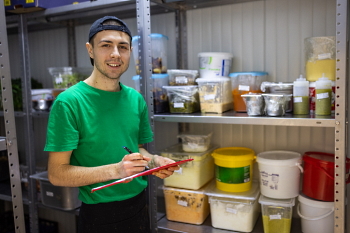
Periodic Automatic Replenishment or PAR Levels are minimum and maximum quantity limits that you set for a certain item. PAR level management might be one of the most important applications on your point-of-sale system, particularly if it also creates dynamic PAR levels that factor in variables like customer behavior, menu mix, and how often you order.
"A system that has dynamic PAR allows you to be more efficient in terms of keeping stock of certain items, "Malbec explains. If guests aren't ordering as many tomato-based items, for example, the PAR for tomatoes can be readjusted to reflect usage. This curbs costs in real-time.
But these systems save much more than money. Malbec argues that their capabilities boil down to inventory that is faster to complete, more accurate, engineered to control costs, and up-to-date. Many of these systems can be integrated with broadline supplier ordering systems. As Malbec explains, they can generate the order for you, so all you need to do is manually review and confirm the order, rather than create it from scratch. "From a labor perspective, you should get to the point where you can hit a couple buttons and order," Malbec says.
For the small independent operator considering an inventory management solution, Malbec says the first step is to think about what you want out of it. This way, you won't get swayed by an impressive demo for a product that has bells and whistles you don't need.
"If you're happy with your POS, call up your rep and ask who they integrate with and start with that," he adds. If your POS has its own solution for inventory, there can be benefits with choosing that inventory system. It's one less thing to worry about. Malbec recommends tools that allow you to automate processes, so you can let the system take care of things rather than continue to do them by hand. Given the many competing demands for an operator's attention, he suggests choosing the simpler system over the more complex one when all other factors are equal.
Tripoli has experience with inventory management systems that integrate with Square, Toast, and TouchBistro. These are all relatively simple to operate and less expensive to implement, so he thinks they're good for independent operators.
Of those three inventory management systems, his favorite provides operators with a lot of actionable data about inventory, sales and food costs. "It's easy to understand, relatively simple to install, and managers don't have a lot of difficulty operating it," Tripoli says.
A Passion for Inventory Management
Omar Pereney, principal at hospitality consulting firm Culinary Matters, claims a passion for inventory management. Pereney says he has tried every system out there, including building one from scratch because he didn't like the commercial options. Pereney is partial to xtraCHEF. "The ROI (return on investment) is easily 5:1 in the first year," he says.
While a strong ROI is compelling in times when operators are looking to save money, Pereney offers this caveat: Operators need to be prepared for a major learning curve and a lot of hands-on time getting an inventory management system like xtraCHEF up and running in their concept.
He explains that xtraCHEF relies on machine learning and isn't usable out of the box. Operators need to feed it data to "train" the system. Specifically, data about each and every item ordered and how products are used (aka, your recipes). This training process can take anywhere from 50 hours to 150 hours, Pereney estimates. It's a necessary step that allows the inventory management system to accurately track how products are used and when it's time to order more based on yield.
PAYING ATTENTION TO SUPPLY SIDE INTERRUPTION AND INFLATION MAKES YOU SMARTER ABOUT YOUR MENU…
Given that a typical restaurant might purchase from several different suppliers, operators need to take a few extra steps to ensure that equivalent items are grouped within the software. Pereney gives an example of a restaurant that might buy their whole milk from different suppliers depending on how they're constructing their order on that day. Each of these suppliers will deliver the milk and use a different tag on the invoice.
Since operators want all their whole milk purchases to show up together in the system, regardless of where they were bought from, the software needs to be trained to recognize all these different product tags as the same item. In other words, what xtraCHEF calls product group.
As a consultant, Pereney has helped restaurants from coast-to-coast, as well as in Alaska and Hawaii, set up their databases in xtraCHEF. "We tell them how to scan the invoices so they have a tidy database and they can build recipes. We teach them how to build and prepare recipes because you cannot do a proper inventory until you have done all your evaluation and created all your prep recipes," he explains the process.

Once everything is set up within the system, xtraCHEF starts to save time. Now, instead of manually writing out everything, team members can use a phone or tablet to quickly take stock of inventory. "Moving forward, every time you purchase the same item from the same vendor, you snap the photo with your phone and it goes in magically," Pereney says. While the process can still feel "tedious" at times, it's vastly more efficient than the old way of keying in invoices line by line and manually counting shelves.
While he is a fan of xtraCHEF, Pereney says he's observed astounding savings for operators who have recently adopted inventory management systems in their business, regardless of the system they are using. He believes the remarkable cost savings are magnified by the current inflation.
For example, Pereney shares his experience with his firm's client Underbelly Hospitality. Pre-pandemic, the Houston-based restaurant group was bringing in $6 million in business; however, they weren't consistently costing out recipes and menu items. They'd been pricing items based on instinct, and that worked when the economy was healthy and business was good. He believes operating on instinct can be translated to losing site of prime costs. Underbelly's sales shrank to $1.8 million during the pandemic. At that point, one of Underbelly's chefs sought a tech-oriented solution.
-

System
Running Inventory Order Guide
The Running Inventory Order Guide is a multi-purpose system that serves as both an ordering tool and a perpetual inventory control for every product in your restaurant or bar. It is ideal for tracking key food items, liquor storage rooms, uniforms, linens, expensive cleaning supplies, smallwares and ...
"Anybody can look at a P&L (profit-and-loss statement) and see that we're supposed to be at a 32 percent [food cost] and we're at 36 percent. But understanding how you get there is what we've gained now with xtraCHEF," according to Nina Quincy, Underbelly's director of operations.
In short, Underbelly started to cost out menu items and reduced costs across their locations by 3 percent, as reported in the case study. In annualized food cost savings, this represented over $330,000 recaptured.
Six Inventory Management Best Practices
Inventory management systems are valuable tools in the hands of operators who apply diligent cost-control measures throughout the house. Here's what Tripoli, Pereney, and Malbec recommended as valuable practices in today's operating environment.
Use realistic PAR levels. PAR levels need to be realistic to what's selling to avoid waste. Inventory management systems can provide the data needed to adjust PARs based on demand, but operators also need to think about when and how frequently they are placing orders. No one wants to be stuck running low on a popular item during the week or overwhelmed with so much of it that a high-value item has to be used up for staff meal.
Stay on top of yield management. Yield management reflects portioning and waste. Have portion control built into the prep list, for example by specifying a quantity of sauce or vegetables needed per shift. If something is off about yield management, do due diligence: Are cooks over-portioning? Is the recipe accurate and up-to-date? Is there a theft issue?
Manage key items weekly. "If you're managing your inventory more frequently, you're able to make minor adjustments and do smarter ordering," Tripoli says. In the current environment, he says it's smarter to check weekly and make orders based on what's being used than to do inventory on a monthly basis when data arrives too late to be acted upon.
Buy in bulk for dry goods. Bulk orders often equate to better prices. While this still ties up cash flow, it can be a good solution for nonperishables that are difficult to reliably source. "If you were able to order a whole bunch, you're sleeping at night," Tripoli says, describing how bulk orders help operators maintain consistency and avoid headaches associated with supply chain delays.
Be disciplined and consistent. Having a consistent process that is done regularly is the best way to stay on top of inventory, whether you're doing it by hand or with a tablet or smartphone. Consistency will help you get actionable data that can save you a meaningful amount of money.
Keep an eye on inconsistencies. "Every restaurant I've done work with will tell me nobody ever steals, and unfortunately, that's just not true," says Malbec. If there are inconsistencies between actual and theoretical yields, Malbec recommends taking an off-cycle inventory on a different weekday. Switching up the point person for inventory is another way to investigate a shortage that could indicate internal trouble. Whenever there are inconsistencies, Malbec advises putting on a detective hat and getting to the bottom of things, and the sooner, the better.
Best Purchasing Practices

Restaurant Consultant Chris Tripoli says that he has seen a lot of smaller independents move away from processed items in favor of fresh ingredients that can change with the seasons. He believes the move towards freshness is a reaction to higher prices. Opera- tors want to offer guests something with a higher perceived value, perhaps to soften the blow of a larger bill. Consumers who may be dining out less to conserve money are also more likely to appreciate items that they wouldn't be able to prepare themselves.
Tripoli says he's also noticed fewer sales of processed and canned ingredients, like a heat- and-serve frozen sauce. "Restaurants have had to step up their game and use better products and fresher products," because they're charging more, he says.
That said, there are pre-prepared items that have the desired freshness and level of quality, which he recommends. Tripoli mentions items like diced peppers, peeled carrots, and shredded lettuce that come rinsed, prepared, and ready to use as-is. This reduces the amount of labor on prep cooks, helping to control costs.
Need an Inventory Management Solution?
Talk to Your Broadline Distributor Rep
Your broadline distributor likely offers inventory management and plate costing applications. Of course, they are designed to encourage you to continue ordering supplies from them, but they are sophisticated tools and a valuable customer benefit. Your broadline distributor sales representative can help you set it up and show you how to use it effectively.
An example is the Sysco Studio system that allows the executive chef or kitchen manager to perform inventory via a mobile device. After inventory is completed, the restaurant can order supplies and schedule delivery. The system automatically adjusts prices and updates another application that calculates the plate cost of each menu item offered by the restaurant and is invaluable for menu pricing decisions. Another feature of the application is menu creation. Independent operators can choose a template and update their menu daily from a printer and copier.
PAR Level 101
PAR is shorthand for "periodic automatic replenishment", the minimum and maximum quantity limits that you set for items in your inventory. PAR level denotes the ideal quantity of an item as deter- mined by usage, yield, re-order cadence, and a number of other factors. It is the attempt to minimize inventory cost and waste without any negative impact on sales.
It is a theoretical figure, and as one might imagine, it is impacted by countless tangible and intangible conditions that cause it to fluctuate over time. Some of these include weather, time of year, other menu choices, price, customer sentiments, local events and activities, in-restaurant promotions, and even staffing considerations.

Veteran restaurant owners will often say that they manage PAR based on tribal knowledge and that they are the best guide for knowing how much of an item to keep on hand. While a confident claim, it is rarely true. High PAR calculations mean more product is ordered than consumed and, as previously stated can lead to either bloated on-hand inventory costs at best or spoiled product and higher food costs at worst. Often the person ordering does not have to view the result of their ordering behavior and as a result, they continue to order at the same levels, which drives the same outcome. Ordering becomes muscle memory and before long the process is so automated that any course corrections as a result of changing market and business conditions go out the window.
Any good inventory system will have several options to break this cycle; Many allow the user to enter a PAR level that is locked, and the system will then compare levels on order or in-house to that number. This is called a static PAR and is ok, but not ideal. As described above, it suffers from the same challenges as a manual PAR level in that it is set by a user who does not have access to all the variables that can positively or negatively influence the number.
The second option and the one favored over a static PAR is a dynamic PAR. In this scenario, the system dictates the ideal PAR level taking into account past purchase history, on-hand balances, ordering levels, and order frequency, and often a number of other factors. The most advanced of these calculations will allow the user to enter events in the area (road closure, college graduation, football game, etc.) and indicate what impact (positive, negative) it is expected to have on business. Additionally, these systems can even look at previous events to see what impact they had then and apply those learnings now.
The predictive PAR systems will help to avoid excessive inventory and reduce spoilage, but they require human assistance to make sure they are accurate. Menus need to be accurately created in the system so that ingredients are properly decremented when a product is sold in the POS.
Regular inventories need to be taken so that an actual versus theoretical usage (AvT) can be calculated and the difference accounted for. Other calculations may be required to determine the yield of a product ordered (think about effective yield of a piece of meat slow-cooked for a day for instance) and those calculations need to be established in the system in order to get close-to-accurate results.
Finally, the staff must have confidence in the calculation. Don't simply dismiss a suggested PAR if it doesn't look right; you should investigate. Often the findings can lead to improved learning or a discovery that can save the restaurant a lot of money.