






Article
Revisiting Menu Design Myths and Truths
One of the most delightful parts of developing a new restaurant is designing the menu that you will hand to guests. After all, we've all read menus and probably have strong opinions about what our menu will look like when the day comes to open our own place.
You might have also read articles or heard podcasts about how to design your menu to maximize sales.
Put a box around your features to make them stand out, these articles say. End all your prices in '9' so they appear to be a better value to your guests. Put your highest-margin items in the top right corner of the page. But is there any truth to these common menu design tips?
A recent New York Times article proposed that operators and guests are nostalgic for physical menus, as QR code menus – which became ubiquitous during the pandemic lose their appeal. If you are looking to revive physical menus in your concept, this could be a good time to review the fundamentals of good menu design. And even if you are sticking with QR menus, some of these pointers might help your digital menus be more effective.
LEARNING OBJECTIVES: |
| By the time you've finished reading this article, you should be able to: |
|
Many menu psychology questions have been tackled by academic researchers in rigorous, real-world studies. This means that they have tested each idea against a control — a menu with a different, neutral design — and used statistical analysis to ensure that the results of each study really do reflect the effect of menu design and not some other factor like server behavior, changes in day of the week, or the weather, all of which can affect what guests order.
By looking at what the academics have found, let us bust some of the most common menu design myths and see some of the suggestions for effective menu design that you may have heard about that might actually boost your sales. (If you would like to dive deeper into the research on which this article is based, you may contact the author at [email protected], and she will send you a list of citations.)
FACT OR MYTH: People read menus starting at the top right corner.
Many menu design consultants will tell you that most people will start reading a book-style menu by opening it up and looking first at the upper right section of the menu, then follow a uniform counterclockwise pattern, ending with looking at the middle of the left page. Because of this snail-shaped reading pattern, those same consultants will tell you to put your features or the items you want to sell most in that upper quadrant of the right page. They call this the sweet spot and note that this often is the best-selling portion of the menu.
Yes, there are people who approach the restaurant business as a science, and you can find them teaching at university hospitality management programs. In this article, a Cornell School of Hotel Administration faculty member evaluates seven menu design theories against published academic research.
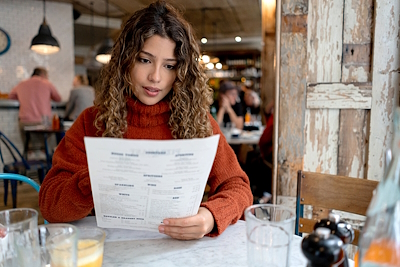
A couple of years ago, one of my colleagues decided to put this idea to the test by having people read restaurant menus while wearing an eye-tracking device. The eye tracker could measure and record each person's visual scan path as they perused the menu. What she found was that people read book-style menus, well, like books: they start at the top left and skim down the first page, then move their eyes to the top right of the facing page and skim down to the bottom, and often return their eyes to the middle of that right page after they have skimmed the whole menu in this methodical way. There was no real difference in how long people looked in any one location on the menu; their eyes may have all followed a similar path, but what caught and held each guest's attention varied substantially. Given these findings, there appears to be no sweet spot in a book-style menu. People will generally look at the two-facing pages of a menu the same way they had read a magazine spread.
As for wall-mounted menus in quick-service restaurants, there is evidence that people are almost as methodical in their scan paths as they are with book-style menus in a sit-down place. A different eye-tracking study looked at three different quick-service restaurants and measured guests' eye movements as they looked at the menus posted above the service counters. Once again, people were consistent in reading down each list, with longer and more frequent viewings of items near the bottom of each list. (That might have been because those items at the bottom of each menu board were closer to the service counter and therefore easier to see.) When there were multiple menu boards positioned side by side, the boards in the middle received by far the most attention. In both studies, it's pretty clear that people use a linear approach to reading a list of menu items.
People read menus starting at the top right corner.
VERDICT: BUSTED!
VERDICT: BUSTED!
What about using the menu to promote items? Can the way you display a menu item or the way you describe it encourage people to buy? There are several myths to investigate here.
FACT OR MYTH? Use boxes or other graphic tricks to highlight the items of which you want to sell more.
It seems logical that there would be a strong relationship between the menu items that attract attention and the sales of those items. This idea is the basis behind all those recommendations to put menu items you want to feature into a box, or to make the text describing those items bigger or brighter to grab your guests' attention as they scan the menu.
And yes, surrounding items with a box or dressing up the graphic design around your specialty items does garner more attention for those items. But there is no evidence that paying special attention to something translates into greater sales of that item. Another restaurant researcher tested the attention-getting equals increased sales myth in a real restaurant, giving some guests a redesigned menu that put a featured item in a box and other guests a plain menu with no boxes and then measuring the effect on sales of the boxed item.
And what they found was that getting attention for your feature sandwich or salad by putting a box around it on the menu doesn't increase sales of that item. Certainly, you can make your menu look attractive by varying the design treatment for different parts of the menu, but do not expect that pretty box or bolder font to sell more items for you.
Use boxes or other graphic tricks to highlight the items of which you want to sell more.
VERDICT: BUSTED!
VERDICT: BUSTED!
FACT OR MYTH? Items placed in the middle of a list of menu items sell more than dishes located at the top or bottom of the list.
Many restaurateurs work on the assumption that items at the top and bottom of a list of offerings are kind of like bookends that frame the range of prices of their items. Notice how many restaurants list their menu items in ascending order of price, with the lowest-priced items listed first and the big splurges last.
These operators believe that most people will then order something in the middle, which means to maximize profits the restaurateurs should position their most profitable items — the ones with low food cost relative to selling price, somewhere midway down the menu between these two extremes. After all, don't most people choose from the middle of the deck when taking part in a card trick?
It turns out that there is some truth to this myth. People treat the high and low prices on a menu as reference points, and many consultants will recommend using decoy pricing: having one item that is higher in price than they expect patrons to normally spend so that the other prices look like a better value in comparison. There is quite a bit of evidence that having a decoy in a set of choices influences a person's eventual selection. So, if you put decoy prices at the top and bottom of your menu, you can push guests towards making a choice from the middle, where perhaps you are placing your most profitable items.
That said, an academic test of menu item sales relative to their position on a printed menu showed that when price is not a concern, people were more likely to pick items at the top or bottom of the list rather than the middle. For this study, the research team took the same list of food items in four menu categories (appetizers, entrees, desserts and non-alcoholic beverages), removed the prices, and then did four versions of the menu that systematically mixed up the order of items within each category.
Participants in the study were asked to pick an item to order and their choices were carefully analyzed to control for potential effects from factors other than position on the menu. The result, in the words of the authors of this study, was that an individual item, no matter how popular or unpopular, benefits from being placed at the beginning or end of its category list rather than in its middle.
Items placed in the middle of a list of menu items sell more than dishes located
at the top or bottom of the list.
VERDICT: BUSTED! (WELL, SORT OF…)
VERDICT: BUSTED! (WELL, SORT OF…)
It is not really the position on the menu affecting sales of an item; it's the perceived price of that item relative to your other offerings that are influencing whether people will buy it.
FACT OR MYTH? Exposing guests to specific menu items frequently makes them more likely to buy those items.
Perhaps you have been to a restaurant where a table tent promotes some signature items that are also featured on the printed menu. Or there is a chalkboard outside with the day's specials written on it as well as a fresh sheet inside the menu describing those same items. Does this repeated exposure to menu items increase the sales of those items? In this case, the research says yes!
Unlike the adage that "familiarity breeds contempt," in the restaurant world, familiarity breeds sales. A Taiwanese restaurant experimented with promoting specific menu items on a blackboard right at the entrance to the restaurant. Those same items also appeared on the restaurant's menu. They rotated through several different menu items to see if "priming" the customers with those items before the guests were seated would increase sales of those choices. And indeed, it did: sales of those menu items increased by 25% or more depending on the menu category.
The research team found that it was more effective to list just the name of the featured items on the chalkboard rather than accompanying the menu item names with a description. (You should note that this research team did not test including a picture or a plate of the promoted item. There is quite a bit of evidence that a great picture or appetizing first look at an item will increase its sales. That is why classic diners have that really enticing display of desserts right at the front door. Who can resist?)
Many of the big restaurant chains have figured out that menu priming works: have you ever noticed that at some chains you will see some menu items repeated in different places on the same menu? That is priming in action. Even without installing a refrigerated display case or adding to your menu length by repeating some items, you may be able to increase sales of a menu item just by exposing your guests to that item ahead of time by listing its name on chalkboard at your restaurant's entrance.
Exposing guests to specific menu items frequently makes them more likely to buy those items.
VERDICT: TRUE!
VERDICT: TRUE!
FACT OR MYTH? Evocative descriptions of menu items boost their sales.
You are bound to have read mouth-watering item descriptions like this one, copied from a major national casual dining chain's menu: A classic, improved! Hand-seasoned beef patty, seared to perfection. Topped with house-made garlic dill pickles, fresh leaf lettuce, tomato, sliced red onions & mustard.
Ok, so it is a regular hamburger. But doesn't it sound much better described this way? It sure does, but do descriptions like this really increase item sales?
There is plenty of evidence that enticing descriptions increase guest perceptions of menu item quality and make customers think the item is going to be pricier than an item that is described much more simply. People even rate food that has more elaborate descriptions as being tastier than simply described items in taste tests, even when the food is the same in both cases. And go ahead and invoke your grandma's recipes on your menu: using references to family recipes for items appears to encourage guests to order.
Nevertheless, not just any kind of description of items you sell in a restaurant works in all cases. Another study looked at whether taste descriptors helped sell more wine and found just the opposite: wines sold better if the description on the wine list did not describe the taste of the wine! From a full review of published studies on menu descriptions, it appears that some descriptions work well some of the time. Focus on making foods sound lovingly hand-crafted out of great ingredients, but don't go overboard with flowery language in your menu item descriptions or your guests will poke fun at you on Instagram.
Evocative descriptions of menu items boost their sales.
VERDICT: TRUE! (MOSTLY)
VERDICT: TRUE! (MOSTLY)
Now, let us examine whether how you display a menu item's price makes a difference to how well it sells.
FACT OR MYTH? You should end your prices with a "9" to encourage guests to buy.
A sales behemoth like Walmart does it, so surely using a gimmick ending to your pricing will work, right? Well, this classic retail pricing strategy does appear to work in restaurants, too. One European study manipulated the pricing in a pizza place and showed that the same item sold much better when it was priced at $7.99 than when it was priced at $8.00. But in this case, the study had a flaw: it could be that people were responding more to the first digit of the price rather than the last, and that 7 sounded notably cheaper than 8, so they bought more when the price started with a lower number.
Other researchers have found that prices ending in 9 works on menus to give the impression of better value. But prices with a 9 on the end are far more prevalent in the quick service or family dining segments of the industry, and with good reason: consumers appear to view how you display your prices as a reflection of quality. In more upscale establishments, ending a menu item in 5 or 0 is a much better strategy as these price expressions seem classier to most people. Before I provide a verdict, however, let us look at the next proposition:
FACT OR MYTH? Don't put dollar signs on your menu prices.
The story goes that starting a menu price with a dollar sign (writing $15 rather than 15 next to an item) or using the word dollars next to a price makes people more conscious of the money they are spending and therefore dollar signs should be avoided when you print up your menu. The same colleague of mine who did the eye-tracking study we discussed earlier also looked at whether the way a menu price is expressed in print influenced sales.
To find out, she tweaked menus in an upscale-casual restaurant over a five-month period, producing some menus that showed prices with dollar signs, some that spelled out the price followed by the word dollars, and some that just showed the price numerically with no dollar sign. After a whole bunch of statistical analysis, she determined that prices expressed as just a number with no dollar sign resulted in a higher average check overall.
Plain numerals also out-performed menus that wrote out the price ("fifteen dollars") in script. But she wisely notes that the effect of typography was tiny in comparison to the many other influences on guest spending. So go ahead and use numerical prices without dollar signs, but do not worry about whether to show the price as 20 or as twenty it's not going to make much of a difference to your guest's purchases.
You should end your prices with a "9" to encourage guests to buy.
VERDICT: TRUE!
VERDICT: TRUE!
Do not put dollar signs on your menu prices.
VERDICT: TRUE!
VERDICT: TRUE!
Believe It or Not
When you are designing your menu, certainly consider some of the psychology behind consumer behavior, but do not believe everything you read or hear. No matter what menu gymnastics you care to adopt, any menu will perform best by adhering to some principles of good graphic design: Use dark text on a light background.
Do not use a font size smaller than 10 points. Use clear, sans serif fonts like Arial for headings, and serif fonts like Times Roman for blocks of text. And save using all caps for headings only. If your guests can happily read your menu, you will sell food. That is a fact.