






Article
Menu Design Myths and Truths
One of the most delightful parts of developing new restaurant is designing the menu that you'll hand to guests. After all, we've all read menus and probably have strong opinions about what our menu will look like when the day comes to open our own place.
You might have also read articles or heard podcasts about how to design your menu to maximize sales. Put a box around your features to make them stand out, these articles say. End all your prices in '9' so they appear to be a better value to your guests. Put your highest margin items in the top right corner of the page. But is there any truth to these common menu design tips?
Many menu psychology questions have been tackled by academic researchers in rigorous, real-world studies. This means that they've tested each idea against a control - a menu with a different, neutral design - and used statistical analysis to ensure that the results of each study really do reflect the effect of menu design and not some other factor like server behavior, changes in day of the week, or the weather, all of which can affect what guests order.
By looking at what the academics have found, let's bust some of the most common menu design myths - and also see some of the suggestions for effective menu design that you may have heard about that might really boost your sales. (If you would like to dive deeper into the research on which this article is based, you may contact the author at [email protected], and she will send you a list of citations.)
1. FACT OR MYTH: People read menus starting at the top right corner.
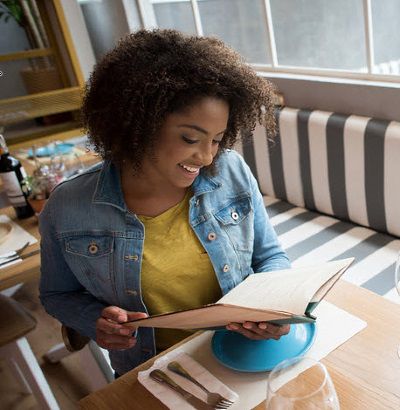
Many menu design consultants will tell you that most people will start reading a book-style menu by opening it up and looking first at the upper right section of the menu, then follow a fairly uniform counterclockwise pattern, ending with looking at the middle of the left page. Because of this snail-shaped reading pattern, those same consultants will tell you to put your features or the items you want to sell most in that upper quadrant of the right page. They call this the sweet spot and note that this often is the best-selling portion of the menu.
Yes, there are people who approach the restaurant business as a science, and you can find them teaching at university hospitality management programs. In this article, a Cornell School of Hotel Administration faculty member evaluates seven menu design theories against published academic research.
A couple of years ago, one of my colleagues decided to put this idea to the test by having people read restaurant menus while wearing an eye-tracking device. The eye tracker could measure and record each person's visual scan path as they perused the menu. What she found was that people read book-style menus like, well, books: they start at the top left and skim down the first page, then move their eyes to the top right of the facing page and skim down to the bottom, and often return their eyes to the middle of that right page after they have skimmed the whole menu in this methodical way. There was no real difference in how long people looked in any one location on the menu; their eyes may have all followed a similar path, but what caught and held each guest's attention varied substantially. Given these findings, there appears to be no particular sweet spot- in a book-style menu. People will generally look at the two facing pages of a menu the same way they'd read a magazine spread.
As for wall-mounted menus in quick service restaurants, there is evidence that people are almost as methodical in their scan paths as they are with book-style menus in a sit-down place. A different eye tracking study looked at three different quick service restaurants and measured guests' eye movements as they looked at the menus posted above the service counters.
Once again, people were pretty consistent in reading down each list, with longer and more frequent viewings of items near the bottom of each list. (That might have been because those items at the bottom of each menu board were closer to the service counter and therefore easier to see.) When there were multiple menu boards positioned side by side, the boards in the middle received by far the most attention.
In both of these studies, it's pretty clear that people use a linear approach to reading a list of menu items.
VERDICT: BUSTED!
To Continue Learning