






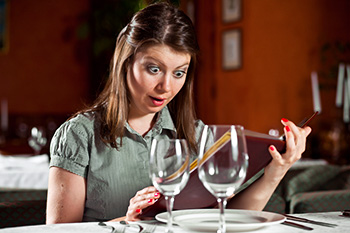
Article
Sticker Shock Therapy
How to Manage Guest Perception That They Are Being Priced Out of Dining Out
Friday night and all the restaurants in your area are hopping, except yours.
You had been busy on most nights of the week; but in the past year or so, your customers seem to be patronizing more affordable competitors. Although you have done your best to keep costs in check, rising food and labor prices have forced you to raise prices.
And now you are concerned that you are pricing your concept out of the market. What now?
First, Identify the Real Problem
First, you must ask if menu prices are driving away guests. The business and trade press often glom onto theories about why certain concepts are failing. Consider that these theories do not necessarily apply to all concepts, let alone yours. You need to diagnose the real issue behind this drop in traffic so you can select the appropriate tactics to get your restaurant busy again.
Learning Objectives:
By the time you've finished reading this article, you should be able to:
- Identify if menu prices are driving away guests.
- Compare your competitors’ pricing and value.
- Raise prices without raising guests’ ire.
This is easier said than done since it is difficult for entrepreneurs to keep their emotions at bay when the business is struggling. That is one of the reasons that restaurant consultants are valuable. In any event, you must do what is necessary to apply cold, hard facts when you are considering making any kind of change to your operation. And that means doing a deep dive into your restaurant’s data.
You have three sources of information to analyze to determine whether pricing is your problem:
- What your competitors are doing?
- What your customers are saying?
- What does your point-of-sale (POS) system tell you about covers, check average, and product mix?
Begin with your POS data. Are cover counts down? How about the average check? A drop in cover counts but no change to check average suggests that while you may be losing customers, the customers who still dine with you are not particularly price-sensitive. A drop in average check but steady cover counts tells you that your customers still like you but are having to dial back their spending. If this is the case, take a closer look at what you are selling (commonly referred to as your “p-mix” or product mix). Analyzing p-mix can help determine whether guests are choosing less-expensive entrees, sharing apps, not ordering that second beverage, or maybe the problem is “all of the above”.
One restaurant I know accommodated a significant rise in protein cost for its sandwiches by bundling them with a side of waffle fries, which used to be only available a la carte. The lower food cost for the fries offset the necessary cost increases for the sandwiches, resulting in a lower overall food cost for the bundle. Customers felt they were getting more value with the bundle and increased their sandwich purchases by close to 10%.
What is more likely these days is that two metrics are dropping simultaneously. You are getting fewer guests and they are spending less per person. If that is the case, look at your competition. Do they appear to be slower as well? If so, then the issue may be broader economic conditions. But if your competitors seem to be bringing in more guests than you are, it’s time to do some in-person reconnaissance.
Visit several restaurants that target the same customers that you do. These competitors do not necessarily have to offer the same menu items as you do. Choose competitors that your guests view as a viable alternative to you, either because they are in the same neighborhood or offer what a typical diner might view as a comparable experience. Make careful notes about how much these operations are charging for all kinds of items including beverages, sides, and desserts. Capture the range of prices for each menu item category, not just the average price across multiple items.
Additional Resources
Competitive Analysis Worksheet
To run a successful restaurant, be vigilant about what your competitors are doing. A competitive analysis is a way of researching and evaluating your rivals in the same market – it only focuses on your competitor’s activities. It helps you learn about their products, sales, and marketing strategies, as well as their strengths and weaknesses.
By doing a competitive analysis, you can find out what makes you stand out, discover gaps and opportunities in the market, and boost your business performance.
Summary of Features & Benefits:
- Helps you know who your competition is
- Helps you spot the competition’s strengths and weaknesses so you can take advantage of them
- Helps you to check if your pricing is right
- Prepares you to create your marketing strategy and improve your business performance
Check out the Competitive Analysis Worksheet here.
Once you have a handle on what your competition is charging for a side salad or a local craft beer, turn to the voice of the customer. Read your most recent reviews on as many platforms as you can monitor and any comments on your social media postings. Do not put stock in one-off compliments and gripes, but rather look for themes. If your pricing is something that comes up again and again, you may have become too expensive for your regular customer base.
What Do Restaurant Consumers Really Think About Price?
Price can become a sticking point for diners when they perceive that what you are offering can be readily replaced by a cheaper alternative. In other words, your restaurant sells a commodity with ready substitutes – including preparing meals at home. If you have read any newspaper articles about the effects of recent inflation on dining out, you have probably seen quotes from consumers such as:
This consumer sees a cheeseburger as an interchangeable good and does not appear to place any value on the experiential aspects of what Restaurant X is offering. To him, a cheeseburger is a cheeseburger. It is simply a commodity.
Consider this excerpt from a recent Wall Street Journal article (Haddon, Heather & Newman, Jesse. Consumers Fed Up with Food Costs Are Ditching Big Brands. Wall Street Journal. May 5, 2024.
At first glance, this might be puzzling. Why would chocolate chip cookies be seen as a commodity good while Oreos are not?
The difference here is a strong, identifiable brand. There are plenty of off-brand versions of chocolate sandwich cookies. Oreos might be perceived as the quality choice even if there is little difference across brands’ recipes or ingredients. So too with restaurants. A strong brand that goes beyond just the food you sell can help elevate your value proposition in guests’ minds.
There is a reason why many chains emphasize the social or experiential aspects of eating at their places. Our angry consumer may also be thinking about what he has paid for cheeseburgers in the past. In other words, the “reference price”.
Consumers get upset when there is a large perceived difference in an item’s reference price (however inaccurate it may be) and the price they see on your menu. Customers who have never dined at your restaurant or do not patronize restaurants like yours are likely to react to higher prices than what they recall from previous years.

Consumers can also react negatively to pricing if they perceive pricing unfairness. Consider the angry guest who is upset about the price of his cheeseburger. To him, $20 is out of line because he equates what it would cost to buy cheeseburger ingredients at the supermarket with the entire cost to produce the item himself, not considering his time, his utilities, or what his home kitchen might cost him in mortgage, insurance, and maintenance. As you well know, these are costs that all restaurants incorporate into their menu pricing. There is not much you can do about changing the attitude of such a customer. They have lost touch with the economics of business.
Other examples of perceived unfairness in pricing are when customers feel they are spending more to have dinner with you when the same items are cheaper at lunch or when something they used to get for free like bread or rolls now comes with a surcharge. A recent National Restaurant Association survey found that 16% of US restaurants applied some kind of surcharge to guest checks, a practice that has many customers fuming about what they perceive as an unfair practice. You need to consider these charges as they can create sticker shock when the check is presented.
Raising Prices without Raising Cain
No one wants their customers to be angry about menu pricing. If you cannot cover costs, you will not stay in business. What can you do when price increases appear to be driving customers away?
Your first line of defense should be increasing value to the guest so that they perceive that they are getting more for their money. One way to do this is by bundling items together so that the bundled price represents a modest saving over buying these items a la carte.
One restaurant I know accommodated a significant rise in protein cost for its sandwiches by bundling them with a side of waffle fries which used to be only available a la carte. The lower food cost for the fries offset the necessary cost increases for the sandwiches, resulting in a lower overall food cost for the bundle. Customers felt they were getting more value with the bundle and increased their sandwich purchases by close to 10%.
It is better to reconsider your menu offerings to charge what you need to than to anger customers with a surprise service charge. To help keep service costs in check, bring bread, crackers, and ice water to each table only on request.
Another approach to adding value is choosing different items to offer as sides or garnishes. In the previous example, the operator’s choice of bundling waffle fries with the sandwiches instead of regular fries was doubly helpful because this potato shape covers the plate well, boosting the plate’s perceived value.
Many of the big chains use buy-two-get-one (B2GO) offers to increase perceived value and drive volume, particularly at off-peak times. The “buy-two” tactic is especially smart because it typically increases party size leading to more beverage sales and possibly additional sales of shared apps or desserts. (Offering only a “buy-one-get-one” deal may backfire if some guests can easily eat two of what you are promoting all by themselves.)
You can also try running value promotions on large, sharable items to bring in groups of diners. A platter of brined-and-fried chicken drumsticks looks enticingly abundant but may have a lower food cost than the same number of wings.
You might also review the range of prices on your menu. Try to maintain a relatively narrow spread of prices within each menu category with the highest item priced not more than 50% above the lowest.
For example, if your lowest price for an entrée is $22, your most expensive entrée should not exceed $33. (For expensive categories like your steak selections, the spread may need to be as low as 25%.) If you have an item that must be priced quite a bit higher than everything else in its category because of food cost, consider making it a special and not printing it on your regular menu.

Whatever adjustments you make to your menu and marketing, be sure you are using appropriate messaging. No one cares that your rent went up or that minimum wage increases are driving up labor costs, but they may be more accepting if they know that your higher prices are a result of supporting local farmers or that you are upholding quality standards. Menu engineering consultant Sean Willard puts it this way: “My favorite line to share for when anyone is nervous about increasing prices is to arm their staff with this simple phrase: ‘We refuse to sacrifice quality so we had to adjust some prices’ and that usually ends all customer debates or anger.”
What Not to Do When Raising Prices
The first thing that many operators try to do when costs are increasing is to charge separately for service items that were originally included in the menu price.
“Nickle-and-diming” your guests for bread or adding a service fee to every bill is seen as an unfair business practice by many, not only guests. There is national momentum toward legislatively banning add-on fees in many services. Consumers should be able to determine what they are spending when they place their order so your menu prices need to account for your costs other than taxes.
It is better to reconsider your menu offerings to charge what you need to than to anger customers with a surprise service charge. To help keep service costs in check, bring bread, crackers, and ice water to each table only on request.
As tempting as it may be in the face of higher food costs, do not cut portion size. Guests get rightfully upset when they are not getting the expected value for their money as evidenced by the recent uproar over “shrinkflation” in the consumer-packaged goods market. Tricks like reducing plate size may go unnoticed by some, but those diners who spot a change in your plates or wine glasses will quickly take to social media to call out such practices.

Likewise, do not reduce the quality of your service by cutting labor. Too few servers on the floor or not having enough cooks on the line will negatively affect the guest experience.
As the owner, you may have to roll up your sleeves and join your team on the floor if you cannot afford as many staff as you have had in the past. Do not ask your management team to do line-level work unless you are willing to pitch in as a food runner or restock the storage room.
Finally, avoid engaging in a price war with your competition. It is fine to adjust the pricing of identical items to match your competitors but do not try to undercut them. Playing at “how low can you go” reduces everyone’s profits. Price cuts may also cut into your servers’ tip income to the point that they may quit, leaving you with the considerable cost of finding and training new staff.
In today’s climate of higher prime costs and rising rents, operators must increase prices to stay afloat. It is never easy and there will always be some guests who will turn away from a price increase. By boosting perceived value on your menu and treating your diners fairly, you are more likely to keep your revenues up and customers coming through your doors.