






Article
The Fundamentals of an Effective Server Training Program
Having been in the restaurant business for most of my life, I've often been asked, "What does it take for a restaurant to be successful?" In my opinion, Stuart Sargent provided the best answer to that question.
Sargent, president and founder of Truluck's Steak and Stone Crab Restaurant in Houston, where I was a managing partner, said five key elements are required for a restaurant to be successful: Great concept, great location, great management, the proper funding, and a lot of "magic."
Full-service dining is coming back strong. But if you are increasing your menu prices to absorb rising inventory and labor costs, no menu is good enough to assure repeat patronage. Your front-line staff needs to provide a great experience. And that requires training.
It was his reference to magic that I found most intriguing. Because, even if you've taken great care to make sure you've created a concept the market appreciates and wants, found the perfect location, hired the best management, and provided enough capital, you still need a little good fortune, luck or "magic" to make your restaurant the success you envision.
Magic is No Accident
By the same token, careful planning and execution can go a long way toward creating that much-needed magic. Independent restaurateurs need only to look at the success of chain restaurants to realize there is a formula for achieving successful growth. While the formulas may differ, the basic elements for success that Sargent described are the same for each. What the chains do better than independents is simple: They develop a system for success. And by creating the system they make it easier for the "magic" to happen.
For full-service restaurants, having a well-documented and effective server (waiter/waitress) training program is arguably one of the most important components of a successful restaurant concept. Your servers are the ones your guests come into contact with the most. They are the face that identifies your concept, your management success, and your vision. Food notwithstanding, chances are that your guests' impression of your restaurant may be defined solely by the service they receive. It is for this reason that many full-service chain restaurants give such a high priority to hiring and training their service staff. I'm not saying that chain restaurants are always successful at it, just that most realize the importance of having a good training program.
The Perils of Training by the Seat of Your Pants
By contrast, many independent restaurants rely on seat-of-the-pants-style training for their new employees.
. . First and foremost, all newly hired employees, regardless of position, should be issued an employee manual that communicates your restaurant's policies, work rules and expectations...
They'll stick the new guy with "one of our best" servers and then hope that they're able to learn "how we do it." The problem with this approach is that the new employee learns the way the other servers do it, not necessarily the way you want things done. Over time, bad habits, shortcuts and "me first" attitudes take precedence over pride, customer service and doing what's expected.
The good news is it's never too late to start doing things right. Developing a successful server training program doesn't necessitate a degree in restaurant management but it does require commitment and thoroughness. This article is intended to provide you with the basic foundation for creating your own server training program.
First: Create a List of Training Tools
A well-rounded server training program has several components. There is not a one-fits-all server training program applicable to all full-service restaurants -- simply because of the many different service styles that restaurants offer. Programs need to be tailored to fit your particular restaurant and service style.
Generally, the most common service style is where a server will be assigned to a designated three-, four- or five-table station in the dining room. Bussers are sometimes assigned to aid servers in things like setting and clearing the table, or helping to keep beverages refilled. The server is responsible for the guest's overall dining experience, beginning with a table greeting and culminating with the payment of the check.
Many fine dining restaurants employ a team service approach rather than individual servers. In this scenario, a two-, three- or four-person team is assigned to a designated group of tables. Typically, most team systems are made up of a front waiter and a back waiter and sometimes include a designated busser. Some restaurants employ a four-person system that includes a captain, front waiter, kitchen or back waiter, and a busser.

Job duties vary depending upon service style; consequently, the training program needs to be varied as well. However, there are some basic tools and practices that can be applied to just about any service style. For the purpose of this article, we'll assume the more commonly used service style.
Employee handbook. First and foremost, all newly hired employees, regardless of position, should be issued an employee manual that communicates your restaurant's policies, work rules, and expectations.
For the employee, the employee handbook gives them a reference guide for their newly acquired workplace. Written properly, the handbook should answer many of the employee's questions regarding restaurant policies, work rules, and benefits. For the operator, it provides a management tool that can be used to enforce the restaurant's expectations and take corrective action.
-

Article
Employee Handbook Basics — Why It's One of the Most Important Documents In Your Restaurant
Effectively communicating information to employees that will ensure they get your message is not as daunting as it seems and can be accomplished by a single medium – the employee handbook.
Orientation. Prior to the training period, each new employee should be given an orientation, preferably by a manager or owner. This is a great opportunity for ownership/management to welcome new employees, let them know what they can expect from ownership/management, and express their expectations of the employee.
This is also a great time to impress your restaurant's culture, mission statement, and purpose.
...One of the biggest mistakes you can make is to assign a trainee to an employee who has not been given proper instruction on how to train...
One of the chief complaints that employees have when dissatisfied with their job is that they were never given a clear set of expectations, or were never shown the right way to do their job. The orientation can lay the groundwork for communicating your expectations. The training program demonstrates how those expectations can be met. But it will be up to management to reinforce those expectations on a daily basis.
Server job description. Every position in your restaurant should have a written job description. The job description should include a summary overview of the job position, a listing of qualifications needed for the job, and a detailed list of the duties and responsibilities of the position. The job description provides the means to convey expectations at the position level.
Side work duties chart. It's common practice to assign side work duties to the waitstaff. Management should provide the waitstaff with a list of opening, running and closing side work assignments for each shift. Typically side work is divided up and assigned to each station. The server assigned to that station is responsible for completing or maintaining the side work in addition to their general station duties such as refilling salt and pepper shakers or wiping down tables and chairs.
Basic side work duties include setup, restocking and cleanup of dining room and service areas. Here are some examples of common side work duties:
- Restock the to-go area with to-go containers, napkins, cups, lids, plastic silverware, and to-go bags.
- Stock and ice down milk and cream.
- Stock sugar and sweeteners, coffee, decaf, tea, and bottled drinks.
- Stock glasses, straws, napkins, coffee cups, and saucers.
- Cut lemons and limes.
- Ice down garnishes.
- Brew coffee and tea.
Station diagram. Most full-service restaurants divide up their dining room into stations consisting of groups of three to five tables. Each station is numbered or labeled, as are the tables in that station. Provide a dining room layout and station diagram for the trainee. This will make it easier for them to learn table numbers and station duties.
Server training manual. Employee training manuals provide the foundation to equip your employees with the knowledge and skills to quickly become productive and capable of creating high-quality dining experiences for your guests. Having a complete and thorough training manual for every position is critical to ensure consistent training when people are hired and for correct, consistent execution in the restaurant regardless of which staff members are on the floor.
An effective training manual should reference and incorporate the use of the other training tools and everyday tools as well, such as opening and closing checklists. It should be presented in a manner that is easy for the trainee to understand and should include an overview of the entire training program.
Material that can be included as either part of the manual or as a separate training tool are:
Menu training. One of the most important segments of training for frontline servers is menu training. Guests almost always have questions about your menu, ranging from how a dish is prepared, to what ingredients are in it, and if substitutions are allowed. Of course, the most common question any server gets is, "What do you recommend?" The trainee should be given a list of all menu items, including detailed descriptions and abbreviations. Photos are an excellent way to help them remember details about the menu. Also, consider having all trainees work the expo line on multiple shifts so they know how each dish is prepared, garnished and presented. Finally, make sure your trainee has an opportunity to sample every menu item you offer.
Customer service standards. Never assume that just because a server has prior table-waiting experience that they have been well trained in customer service. In fact, customer service training should be ongoing and reinforced daily in shift meetings.
Prepare a list of service standards that applies to your entire staff; however, emphasize customer service standards for servers. Topics for service standards might include:
- Handling guest complaints.
- What to do if ticket times are too long.
- Fraternization guidelines.
- Making a guest feel welcomed.
- Going beyond guests' expectations.
- The meaning of hospitality.
- Always try to say "yes."
- Never pick up tips while guests are still seated.
- Helping the physically impaired.
- Inviting guests back.
Steps of service. Posting a "Steps of Service" chart provides a great reference for both the front- and back-of-house staff. Note that the sample chart below lists the expected order of service for each step of the guest dining experience. It also includes ticket time expectations that reflect the collective goals for both kitchen and service. Guest expectations are largely dictated by the restaurant concept. Restaurants with higher check averages usually have longer table turns than lower-check average concepts.
Shift opening and closing procedures. Trainees should be provided a complete list of the jobs and duties they are expected to do from the time they arrive until the time they clock out. Servers should be provided an opening and closing checklist as well as expected side work duties.
Point-of-sale training. Your training program should allocate sufficient time for new servers to learn how to use the point-of-sale (POS) system. Many restaurants rely on the POS system for kitchen timing, menu item sales mix, and proper guest check tabulation. Inaccurate check ringing can lead to havoc on the kitchen line, incorrect orders and dissatisfied guests.
Server banking. Typically, many full-service restaurants that use POS have their servers ring and collect sales. At the end of the shift a report is run and the server turns in the cash and credit card vouchers collected. Proper instruction should be given to:
The good news is it's never too late to start doing things right. Developing a successful server training program doesn't necessitate a degree in restaurant management, but it does require commitment and thoroughness.
- Server checkout procedure.
- Tip split or sharing.
- Credit card procedure.
- Handling comps, discounts and "over-rings."
- What to do in the event of walkouts.
- Shortages.
- Wine service. If you have an extensive wine list then wine most likely makes up a good percentage of your sales. Staff should be trained both in the knowledge of your list as well as the proper service technique for wine.
Alcohol awareness training. Establishments that serve alcoholic beverages have a responsibility to provide their staff with the necessary training to responsibly sell and serve alcoholic beverages. In the United States, most states require servers of alcoholic beverages to participate in state-certified alcoholic beverage training in addition to the training they receive from their employer. A good employer-sponsored program should include facts about regulations, the service of minors, the effects of alcohol, methods of detecting intoxicated patrons, intervention methods, a blood alcohol content (BAC) chart, a test for servers, and a course completion certification.
Safety and sanitation policies. Emphasis should be given to safety, security, and sanitation practices. Typically these issues are addressed in the employee handbook. Your training program should include time set aside for review of your restaurant's policies and procedures.
Create a Training Schedule
It's important for a trainee to know how long the training period lasts and when they are expected to train. The number of days or shifts for your server training program will be dependent upon several factors such as the complexity of your menu, your wine list, service procedure, server job functions, or POS training. Keep in mind, though, that servers work for tips; most can't afford to make minimum training wage for an extended period of time.
The schedule should follow the training procedure established in the training manual, ensuring that all phases of the training process can be completed in an orderly fashion.
Qualified trainer. One of the biggest mistakes you can make is to assign a trainee to an employee who has not been given proper instruction on how to train. When choosing trainers, select staff members who have patience, want to be trainers, are good at being a server, and are willing to teach according to a set of training guidelines rather than off-the-cuff methodology.
Trainer's guide. A trainer's guide can be a useful tool in helping the trainer stay organized and to ensure all of the training material is covered. At a minimum, the trainer's guide should provide a step-by-step process that coincides with the training schedule and the material in the server training manual.
A more advanced trainer's guide might include in-depth "train the trainer" instructions that help the trainer to be more effective. For instance, it might include an overview of various training techniques and how to apply your preferred training style to different training situations and content. Advice on how to deal with shy, anxious or even obnoxious trainees can be useful to the trainer as well. The better you equip and "train the trainer," the better trained your new employees will be.
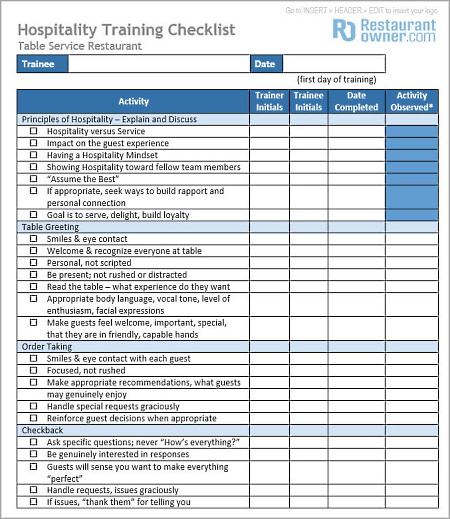
Server training checklist. This form can be used to verify that all key training objectives established in the training manual and training schedule have been met. It includes a list of activities in which you want your trainee to become proficient or to have completed. Typically both the trainer and trainee will sign off on each activity. The example checklist below lists some activities commonly associated with server training programs.
Put the Training to the Test
No operator wants to put an untrained (or undertrained) server on the floor who won't be able to answer guests' questions or serve them efficiently. One of the best ways to ensure that trainees learn is to have them undergo testing for various phases of the training process. Generic tests can be devised for general topics such as customer service, sanitation and safety, but, more importantly, each restaurant should devise short tests that are specific to their restaurant training program. The tests can be as long or short as necessary, and they don't need to be complicated.
If you don't have a testing system, recruit staff members to help you devise one. Rather than have one long test, consider creating a series of short tests for each phase of training. Some of the more common areas of testing include:
Company history/Concept statement. It is important that servers be able to answer basic customer questions like, "When did you open?" or "Is this the only location?" or "Where did the name 'Blue Fish Grill' come from?" Much of this can be covered during orientation and training, but giving the trainee a short quiz can help them retain this information.
Menu descriptions. Dedicate a large portion of the training process to helping the trainee learn your menu and giving them the ability to describe it. Fortunately, trainees can study your menu on their free time (homework) and then observe it during training. Create the test by using a combination of multiple-choice, essay, true-or-false, and fill-in-the-blank questions about your menu. Example: The Southwest Chicken Salad is served with ______________ dressing.
Menu abbreviations. The increasing use of POS systems in restaurants has greatly reduced the need for servers to remember menu abbreviations. However, if you're still using handwritten guest checks for submitting orders to the kitchen or bar, then having a standard menu abbreviation list helps to prevent incorrect orders and reduce the time it takes a server to write the order.
Responsible alcohol service. Fortunately, there are a variety of generic tests available through alcoholic beverage regulatory agencies, state restaurant associations and companies that teach responsible alcohol service courses. (See below for more information.)
Table identification (seating chart). This test is easily prepared by simply taking a seating chart and removing the table and station numbers from it. Have the trainee then write the table numbers and stations on the chart.
Restaurant policies. A good way to make sure the trainee has read the policies and procedures listed in the employee handbook is to create a test on the material listed in the handbook.
Bolster In-House Training With Proven Standardized Certifications
Responsible alcohol service certification. Just about every alcoholic beverage jurisdiction requires that servers of alcoholic beverages undergo some type of training certification before they are allowed to serve alcoholic beverages.
Learn More…
The National Restaurant Association Educational Foundation offers its ServSafe® Alcohol program online at www.servsafe.com/servsafe-alcohol/. The program is nationally recognized and accredited and is accepted by numerous jurisdictional agencies. Check with your local alcoholic beverage control agency for requirements (if any) that pertain to your restaurant.
Food safety certification. Most all health and sanitation regulatory agencies require that the manager or designated employee be certified by passing a food safety course. The ServSafe® program includes a nationally recognized and accredited manager certification for food safety as well. However, some locales stipulate that any person handling food for public consumption be certified in food safety, meaning that servers must pass a food safety certification course as well. Again, check with your local health and sanitation department for requirements.
Good Training is Good Business
Most restaurateurs know that the best form of advertisement is by word of mouth. One surefire method to build positive word of mouth is to invest dollars into your staff. You can never give them too much training. In fact, training needs to be ongoing -- repeated in shift meetings, reflected in day-to-day management and integrated into the culture of your restaurant.
Proper training promotes employee retention and raises the quality of your staff. But the real benefit of an effective training program is that your staff becomes your best marketing tool.
-
Download
Service Steps Chart for Tableservice Restaurants
Great service begins by knowing the basic steps of service that guests expect. This customizable chart can be used in training your staff the basic service steps expected for all tableservice restaurant concepts.
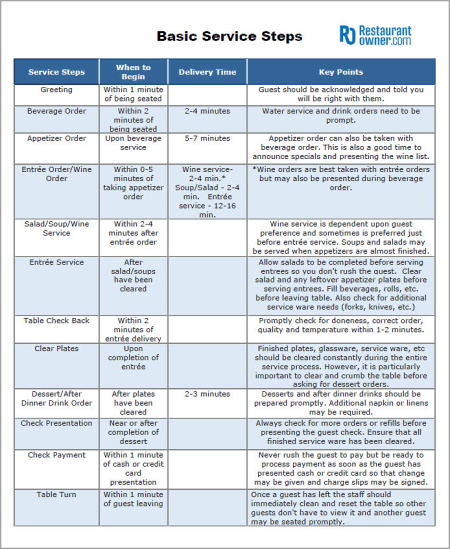
This chart lists the expected order of service for each step of the guest dining experience. It also includes ticket time expectations that reflect the collective goals for both kitchen and service. Bear in mind, that guest expectations are largely dictated by the restaurant concept. Restaurants with higher check averages usually have longer table turns than lower-check-average concepts. Refer to text in "Steps of Service" above for more detail.
-
Download
Server Training Checklist
Make sure new servers are ready before they're one on one with your valuable customers. This checklist will help managers and trainers track and document the training steps of your server trainees. Includes detailed server training steps such as menu abbreviations, assembling an order, food running, ...

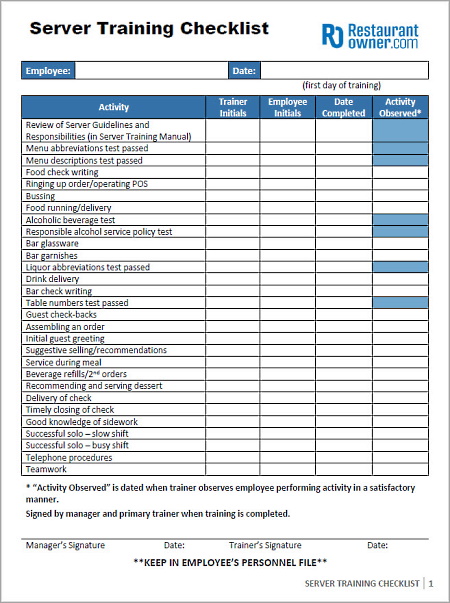
Use this form to verify that all key training objectives established in the training manual and training schedule have been met. Refer to the text in "Trainer's Guide" above, for more detail.
-
Download
Hospitality Training Checklist
The hospitality skills of your service staff often have a greater impact on the perception of your guests' experience than the quality of your food or service. Servers need to know more than just the mechanical and technical aspects of service. Use this checklist as a training tool for new servers so ...